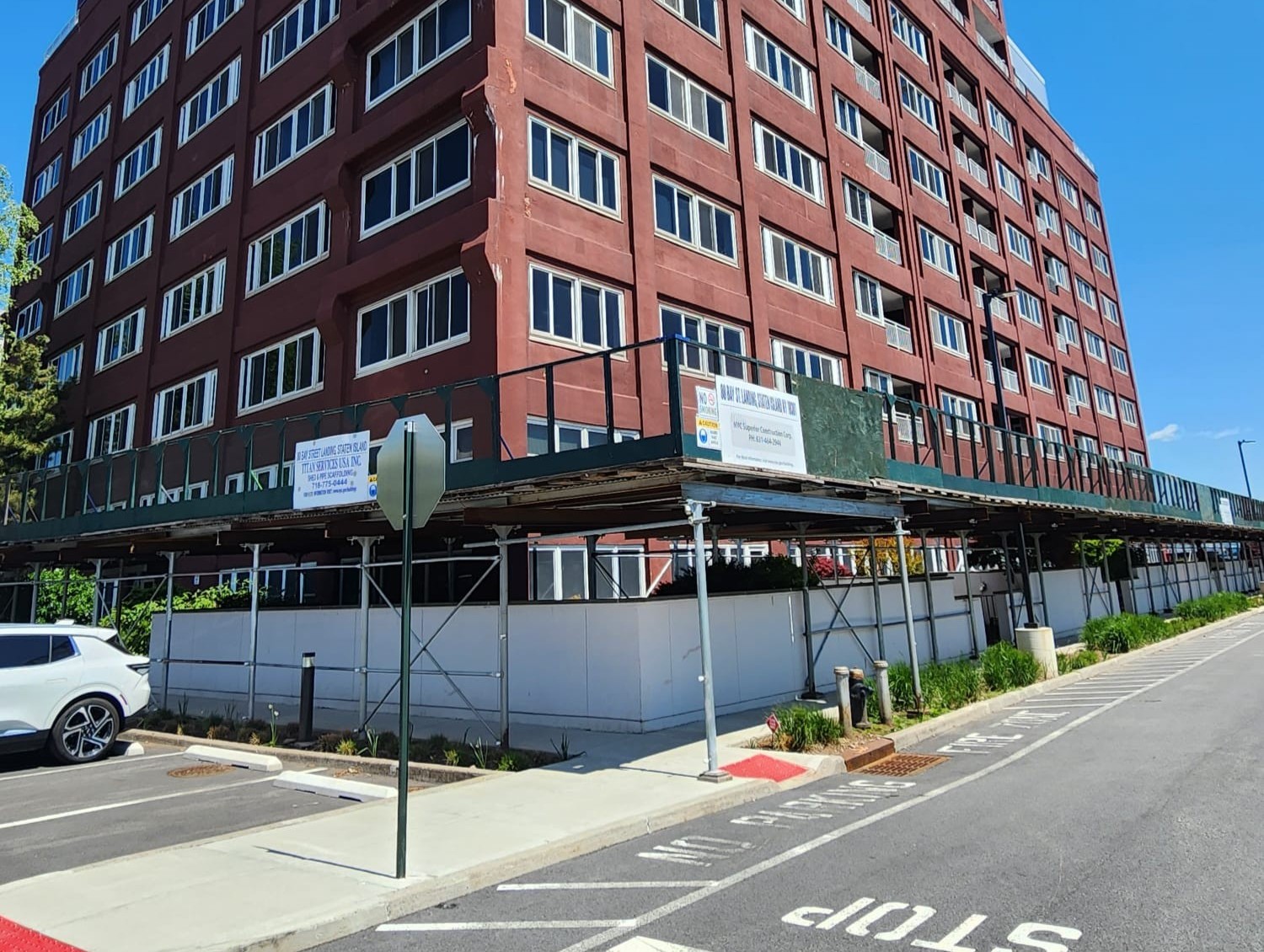
If your building has a sidewalk shed, you already know the two things everyone knows about them: they are expensive, and they never seem to come down.
That second part is no longer true, at least not legally. As of early 2026, New York City has rewritten the rules around sheds, and the city is now charging owners money for exactly the thing most buildings have been doing for years: leaving the shed up while the underlying repair sits on a shelf.
Here's what actually changed, what the clock now looks like, and the real sequence for getting a shed off your sidewalk.
Why your shed went up in the first place
Almost every long-standing shed in New York traces back to the same document: a facade inspection report.
Under the Facade Inspection & Safety Program (FISP, still widely called Local Law 11), buildings taller than six stories must have their exterior walls examined by a Qualified Exterior Wall Inspector every cycle. That inspector files the building as Safe, SWARMP, or Unsafe. When conditions are classified Unsafe, public protection goes up immediately. That's your shed, and it stays until the condition is corrected.
The shed is not the problem. The shed is the symptom. It comes down when the masonry is fixed, and not one day before.
What changed in 2025 and 2026
The City Council passed a package of laws in April 2025 as part of the "Get Sheds Down" initiative. Two of them matter enormously to your budget.
Local Law 48: 90-day permits, no auto-renewal
Sidewalk shed permits used to run a year and renew almost automatically. That is over. Permits issued or renewed on or after February 2, 2026 have a maximum duration of 90 days and do not auto-renew in DOB NOW. Each renewal carries a fee, and beginning with the second renewal, the owner has to demonstrate that work is actually being performed to address the condition the shed was erected for, documented by a registered design professional.
If work isn't underway, monthly penalties accrue, scaled to the length and age of the shed. And here is the part that catches boards off guard: you cannot renew a shed permit while DOB shed penalties are outstanding. Fall behind on the fines and you can end up with an unpermitted shed on a public sidewalk, which is its own violation.
There are exceptions. Sheds tied to new construction, enlargement, or demolition permits aren't subject to the shortened duration, and one- and two-family homes are carved out of the penalties.
Local Law 51: hard milestones with $5,000–$20,000 penalties
This is the one that changes how you have to plan. Once an initial shed permit is issued in the public right-of-way, the clock starts:
| Milestone | Deadline from initial shed permit |
|---|---|
| File complete construction documents | 5 months |
| File an acceptable work permit application | 8 months |
| Complete the facade repairs | 2 years |
Miss any of the three and DOB may assess a penalty of not less than $5,000 and not more than $20,000. Extensions are possible at the Commissioner's discretion, but you have to document the reason, whether that's material lead times, access disputes or financial hardship, and you shouldn't plan around getting one.
These penalties stack on top of the existing FISP fines. Late filing of a facade report runs $1,000 per month, with a separate annual failure-to-file penalty of $5,000, and there are additional monthly penalties for failing to correct Unsafe and SWARMP conditions.
One more: the shed itself got more expensive
Local Law 47 raised the minimum clearance beneath sidewalk sheds from eight feet to twelve, effective August 2025, and increased lighting requirements. Taller sheds cost more to build. If you are pricing a shed today against a number you were quoted in 2023, expect the gap.
What a shed is actually costing you right now
Most boards underestimate this because the cost arrives in pieces.
- Installation: a one-time number driven by linear footage, height, and site complexity
- Monthly rental and maintenance: the line item that quietly runs for years
- Permit fees: now recurring every 90 days instead of annually
- Penalties: the new LL48 monthly accrual plus LL51 milestone fines
- Retail and residential impact: ground-floor tenants lose visibility and foot traffic, and sheds are consistently cited in rent negotiations and lease renewals
Typical NYC ranges: on a 100-foot frontage, installation generally runs $15,000–$30,000, with monthly rental and maintenance in the $2,500–$6,000 range depending on height, lighting requirements, and site complexity.
Run the arithmetic on a three-year shed and the number frequently exceeds a meaningful share of the repair itself. That was always true. What's new is that the city is now adding penalties on top of it.
The actual sequence to get the shed down
There is a defined path, and the buildings that get sheds down fastest are the ones that run these steps in parallel rather than in series.
- Get the report and understand the scope. Your QEWI's report identifies the conditions that triggered the Unsafe classification. Read the actual conditions, not just the summary. There is often a meaningful difference between what must be repaired to clear the Unsafe designation and what the engineer recommends for the full building.
- Have the engineer or architect produce construction documents. This is your five-month milestone. Do not wait for board consensus on financing to start design. Design takes time and the clock does not pause for a funding discussion.
- File for permits. Eight-month milestone. Straightforward if the documents are complete.
- Bid the work properly. Three to five qualified restoration contractors, bidding the same documents, with a clear scope for unit-price items like brick replacement and lintel work. Facade jobs are notorious for change orders because quantities can't be fully known until the wall is opened. A good bid isolates that variability into unit prices instead of leaving it as a surprise.
- Build. For most mid-size masonry restorations this is a season, not a year. Weather is the real constraint. Masonry work has temperature limits, and a job that misses the fall window often loses several months.
- Correct, then file the amended report. Once all unsafe conditions have been corrected, an amended report must be filed with DOB within two weeks. This is the step that legally clears the condition.
- Remove the shed. Permit closed, sidewalk back.
The mistake that keeps sheds up for a decade
Buildings almost never get stuck on the construction. They get stuck between the report and the design.
A board receives an Unsafe finding, gets a number that's larger than expected, and decides to think about it. There's no assessment in place, no reserve to draw on, and no urgency because the shed is up and the building is technically protected. Six months become two years.
Under the old rules that was merely expensive. Under Local Law 51 it now generates penalties within five months of the shed going up. If your building put a shed up in the last year, the LL51 milestones are already running, and the first one is very close.
What to do if your shed has been up a long time
If your shed predates the new rules, the milestone penalties under LL51 attach to permits issued on or after the law's effective date, but the LL48 renewal requirements apply to your renewals going forward, which means at your second renewal you will need a design professional to certify that work is being performed. If nothing is happening, that's when the monthly penalties begin.
The practical read: an old shed is not grandfathered into indefinite quiet. Get a scope, get a number, get a schedule.
A word on timing your repair with your FISP cycle
Cycle 10 filing windows run by tax block:
- Sub-cycle 10A: blocks ending 4, 5, 6, or 9: February 21, 2025 to February 21, 2027
- Sub-cycle 10B: blocks ending 0, 7, or 8: February 21, 2026 to February 21, 2028
- Sub-cycle 10C: blocks ending 1, 2, or 3: February 21, 2027 to February 21, 2029
If you're in 10A, you have a hard filing deadline coming in February 2027, and any SWARMP conditions carried over from Cycle 9 need to be corrected before that report. Buildings that start scoping work in the fall of 2026 will be bidding into a crowded contractor market. Buildings that start now will not.
Separately, DOB has been studying whether the five-year cycle should be lengthened. Local Law 49 directs the periodic interval to fall somewhere between six and twelve years, and DOB has proposed moving to six. That rulemaking is still in progress. Until it's final, Cycle 10 deadlines stand exactly as published.
Talk to someone who does this work
NYC Superior Construction has restored 34 facades across New York City, Nassau County, Westchester County, and Rockland County, and Central NJ and North NJ, from $25,000 to $1,500,000. 20+ years in business, $700,000 bonding capacity per project. We work from your engineer's documents, price unit-rate items honestly up front, and build schedules around getting the shed down, not around stretching the job.
If you have a shed up and no plan behind it, send us the FISP report and we'll tell you what the repair scope realistically looks like and what it will take to close it out. No charge for the conversation.
Frequently asked questions
How long can a sidewalk shed legally stay up in NYC?
There's no absolute maximum, but permits now run 90 days and must be actively renewed, and after the second renewal the owner must document that repair work is underway. Penalties accrue monthly when it isn't.
Can I take the shed down before the repairs are finished?
Not while an Unsafe condition exists. The shed is public protection. It comes down after the condition is corrected and the amended report is filed.
Do these rules apply to buildings under six stories?
FISP applies to buildings taller than six stories. But the sidewalk shed rules apply to sheds in the public right-of-way generally, and Local Law 126's annual parapet observation requirement applies to buildings of any height with a parapet fronting a public right-of-way.
Who files the amended report?
Your QEWI, the licensed engineer or architect who performed the examination. It must be filed within two weeks of the conditions being corrected.
What if we can't afford the repair right now?
Talk to your engineer about phasing. Repairs that clear the Unsafe designation can sometimes be separated from longer-term restoration work, which gets the shed down sooner and spreads the cost. It is worth pricing both approaches before the board votes.
This article is general information about New York City building regulations, not legal advice. Rules and penalty amounts change, so confirm current requirements with the NYC Department of Buildings or your design professional. Last reviewed: August 9, 2026.