Every five years, buildings taller than six stories in New York City get examined by a Qualified Exterior Wall Inspector, and every five years a large number of boards receive a report with an acronym on it that nobody outside the industry has ever heard of.
SWARMP. Safe With A Repair And Maintenance Program.
It sounds mild. It is routinely misread as "you're fine, keep an eye on it." That reading costs buildings real money, and under the current rules it costs more than it used to.
Here's what the designation actually means, what obligation it creates, and how to handle it without either overreacting or letting it drift.
The three classifications, plainly
Your QEWI must file the building as one of three things:
Safe. No conditions requiring repair. Relatively uncommon in a city where the median building is decades old.
SWARMP. Conditions exist that are not currently hazardous but will become hazardous if left alone. Your engineer is required to project when. The report should state the month and year the inspector expects the defect to deteriorate into an Unsafe condition.
Unsafe. A present hazard. Public protection goes up immediately, and the condition must be repaired within 90 days of the report being filed, with an amended report submitted within two weeks of correction.
The mental model that helps: Unsafe means fix it now. SWARMP means fix it before your next report. It is a deadline, not a suggestion.
What SWARMP actually obligates you to do
This is the part boards miss.
A SWARMP condition must be corrected before you file your next cycle report. If you file the next cycle with the same conditions uncorrected, you're exposed to failure-to-correct penalties, and your engineer may be obligated to reclassify the building.
So the real deadline on a SWARMP designation is your next FISP filing deadline. For Cycle 10, those are:
| Sub-cycle | Tax block ends in | Filing window closes |
|---|---|---|
| 10A | 4, 5, 6, 9 | February 21, 2027 |
| 10B | 0, 7, 8 | February 21, 2028 |
| 10C | 1, 2, 3 | February 21, 2029 |
Find your tax block number on the DOB NOW portal, and it's public, along with your past filings, violations, and compliance status. DOB also publishes an interactive map color-coding every subject building in the city by filing status, which means your compliance posture is visible to anyone who looks, including prospective buyers and lenders.
If you're in sub-cycle 10A and carrying SWARMP conditions from Cycle 9, you are the group with the shortest runway. Design, bid, and construction for a mid-size masonry restoration typically consumes twelve to eighteen months once you account for board approval and weather windows. February 2027 is closer than it looks.
Why "we'll deal with it next cycle" backfires
Three reasons, in order of how much they cost.
Deterioration is not linear. A cracked lintel doesn't stay a cracked lintel. Water gets behind the facade, freezes, expands, and takes brick with it. The repair you priced in year one is frequently not the repair you're buying in year four, and the difference is rarely small. Spalled brick becomes displaced brick becomes a wall section.
SWARMP becomes Unsafe. Your engineer already told you when they expect this. When it happens, you're not on a five-year clock anymore. You're on 90 days, with a sidewalk shed, which brings its own monthly cost and, as of 2026, its own escalating penalty regime under Local Laws 48 and 51. Once a shed permit is issued you have five months to file construction documents, eight months to file a work permit application, and two years to complete the repair, with penalties of $5,000 to $20,000 for each milestone missed.
Penalties compound. Late filing runs $1,000 per month with a separate $5,000 annual failure-to-file penalty, and there are recurring monthly penalties for uncorrected conditions. None of this money buys you any masonry.
The buildings that handle facade compliance well treat a SWARMP report as the start of a capital project. The buildings that handle it badly treat it as a piece of paper to file.
How to read your report like an owner, not a bystander
Ask your engineer these five questions. Every one of them affects your number.
- Which conditions are actually SWARMP, and which are recommendations? Most reports contain both: code-driven repairs and good-practice suggestions. They are not the same obligation. Separate them into two columns before you build a budget.
- What is the projected date each condition goes Unsafe? The report is required to include this. It's your scheduling backbone.
- What's driving the deterioration? Repointing a wall that's failing because of a roof or coping problem means repointing it again in six years. The underlying water path matters more than the visible damage.
- Can this be phased? Sometimes yes, by elevation, by condition type or by severity. Phasing spreads cost across fiscal years and can be structured to keep the building out of Unsafe territory. Sometimes no, because mobilization and access dominate the cost and splitting the job means paying for scaffolding twice. Your engineer and a contractor should both weigh in.
- What are the access and staging constraints? Rear yards, adjacent property agreements, and sidewalk conditions drive real cost. Access agreements with neighboring buildings are one of the most common sources of schedule slippage on facade projects, and they take months to negotiate. Start them early.
What this work typically costs
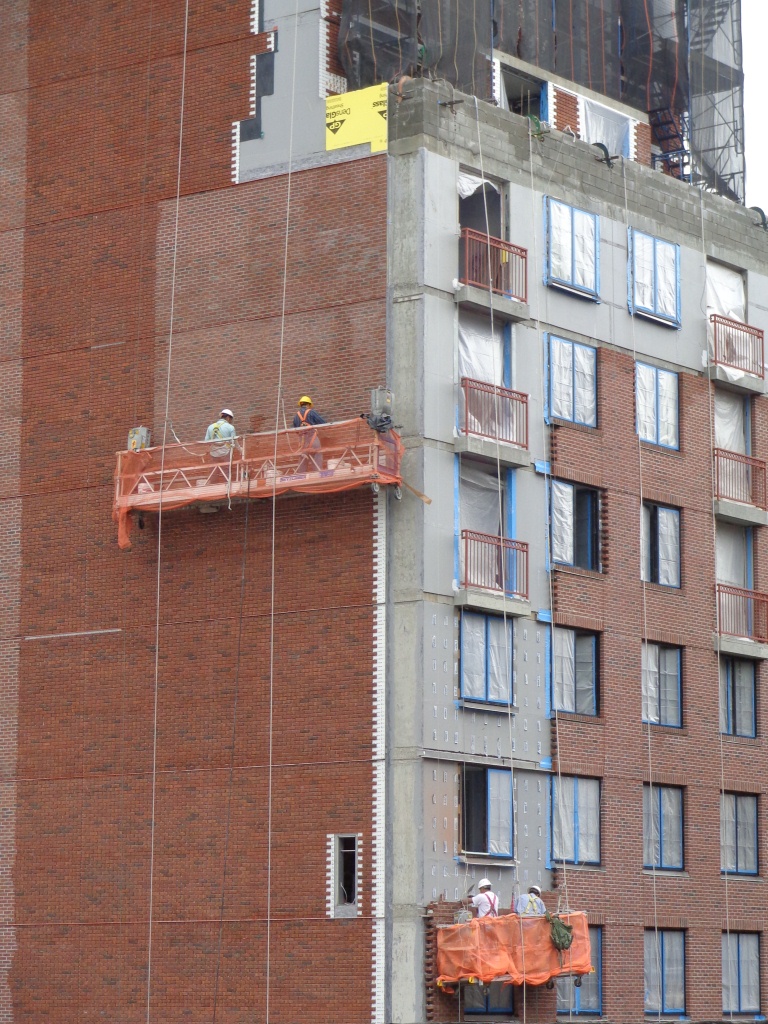
Facade restoration pricing is driven by a small number of variables: square footage of wall, the type and severity of conditions, access method (suspended scaffold, mast climber, pipe scaffold, shed), the masonry type, and the quantity of unit-price items that can't be known until the wall is opened.
Typical NYC ranges: repointing generally runs $18–$35 per square foot, brick replacement $45–$85 per unit installed, and lintel replacement $1,200–$3,000 each, depending on span and steel gauge.
The single most useful thing you can do at bid stage is insist that unit-price items be priced up front. Facade quantities are always estimates. Nobody knows exactly how many brick need replacing until the scaffold is up. A bid that fixes the unit rates in advance turns the unknown into arithmetic instead of a negotiation you'll be having from a weak position.
Be careful comparing bids that aren't built on the same document set. A low number often means a narrower scope, not a better price.
Funding the work
Boards generally have four routes, and most use a combination:
- Reserves, if the building has funded them
- Special assessment, spread over one or more fiscal years
- Building loan or line of credit, which many co-ops use to avoid a large one-time hit to shareholders
- Phasing, treating the project as two or three capital cycles
Worth knowing: deferred structural maintenance and pending special assessments now show up in condo lending questionnaires, and buildings with unresolved facade issues can face problems getting units financed. That is often the argument that moves a reluctant board when the safety argument hasn't.
The one thing to do this week
Pull your building's status on DOB NOW. It takes five minutes and it's free. Confirm three things: your sub-cycle, your current classification, and whether you have any open facade violations or accrued penalties.
If you're SWARMP in sub-cycle 10A, put design on the next board agenda. Not the repair. The design. That's the step with the longest lead time and the one that unlocks everything else.
Get a real number before you go to the board
NYC Superior Construction restores masonry facades across New York City, Nassau County, Westchester County, and Rockland County, and Central NJ and North NJ. 20+ years in business, 34 completed facade projects, $700,000 bonding capacity per project. We work from your engineer's documents, price unit-rate work transparently, and give boards a scope and schedule they can actually vote on.
Send us your FISP report and we'll come back with a realistic scope and budget range. Free, and no obligation to bid.
Frequently asked questions
What does SWARMP stand for?
Safe With A Repair And Maintenance Program. It means your facade has conditions that are not currently hazardous but will become hazardous without repair.
Is SWARMP a violation?
No. It's a valid compliance status. But it carries an obligation to correct the conditions before your next cycle report, and failing to do so can generate penalties.
How long do I have to fix SWARMP conditions?
Before your next FISP filing deadline. Your engineer also projects a date when each condition is expected to become Unsafe, which may be sooner.
What's the difference between SWARMP and Unsafe?
Unsafe is a present hazard requiring public protection and repair within 90 days. SWARMP is a future hazard requiring repair before the next cycle.
Can a SWARMP building be reclassified as Safe?
Yes, once the conditions are repaired and an amended report is filed by your QEWI.
Do I need a sidewalk shed for SWARMP conditions?
Not for the designation itself. Public protection is required for Unsafe conditions, and may be required during the repair work depending on the method and location.
This article is general information about New York City building regulations, not legal or engineering advice. Requirements and penalty amounts change, so confirm current rules with the NYC Department of Buildings or your QEWI. Last reviewed: August 9, 2026.