
Most owners check that their facade contractor "has insurance" by asking for a certificate and filing it. In New York, that isn't enough. The state's Scaffold Law puts owners on the hook for most fall injuries on their property, and the policy behind the certificate can contain exclusions that leave the owner exposed for exactly those claims. A certificate can look perfect while the policy behind it protects you very little.
Our general guide to choosing a masonry contractor touches on insurance briefly. This post goes through it in detail: which policies a facade contractor should carry, the endorsements to require, the exclusions to look for, and how to check what you've been given. Your insurance broker and attorney should make the final call on your requirements. This is meant to help you ask them the right questions.
Why New York is different: the Scaffold Law
New York Labor Law Section 240(1), known as the Scaffold Law, makes owners and contractors responsible for most gravity-related injuries to construction workers: falls from scaffolds, ladders and roofs, and injuries from falling objects. The owner doesn't have to have done anything wrong, and in most cases the worker's own carelessness isn't a defense. Labor Law Section 241(6) adds liability for violations of specific state safety rules.
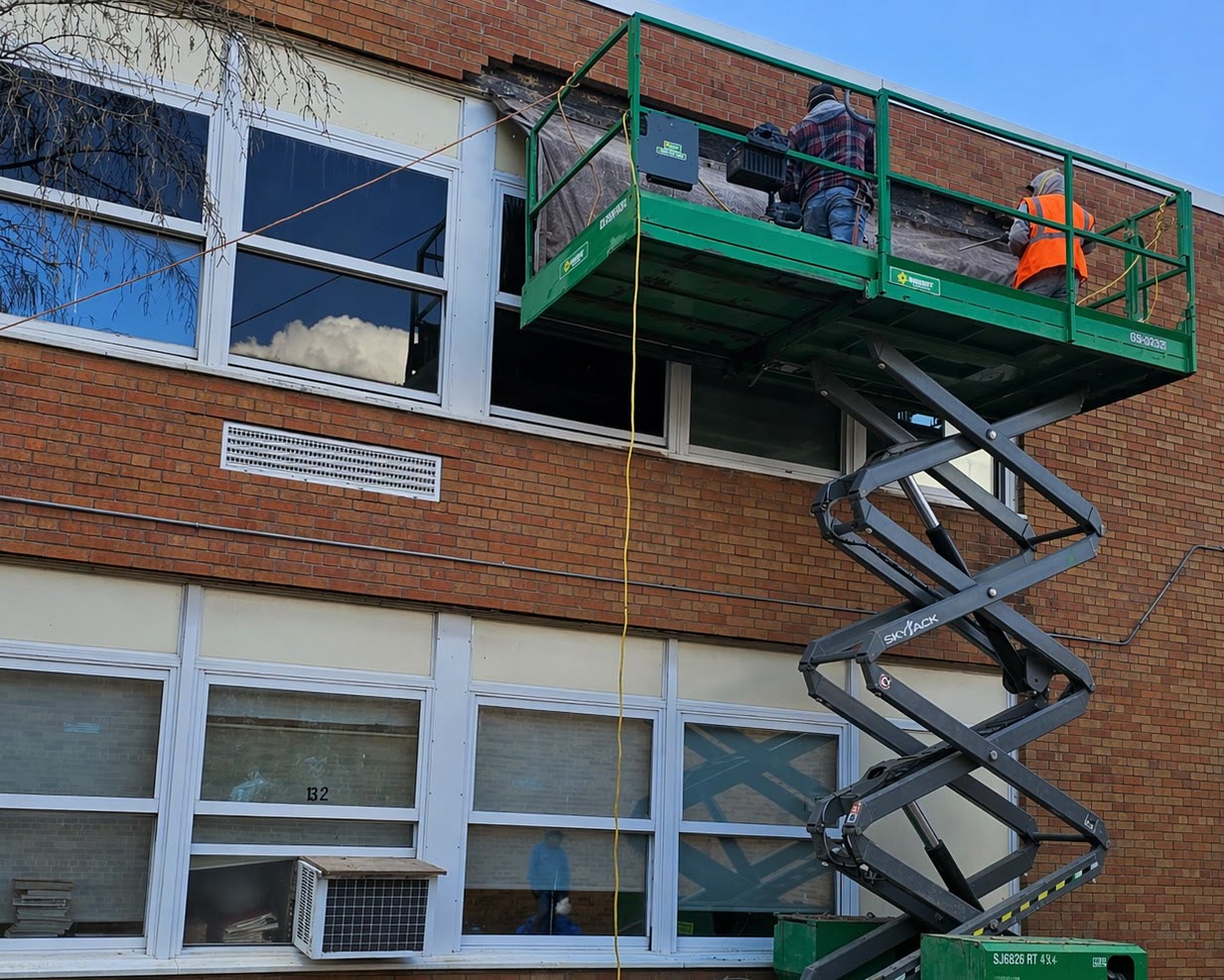
Facade work happens at height, with heavy materials overhead. When a worker is hurt, the usual pattern is that the worker collects workers' compensation from the employer and also sues the building owner under the Scaffold Law. The owner then looks to the contractor for indemnity under the contract and to the contractor's insurance as an additional insured. If that chain has a gap, the owner's own policy (and the board's budget) absorbs the claim. Scaffold Law verdicts and settlements regularly run to seven figures.
The policies a facade contractor should carry
| Coverage | What it does | What to look for |
|---|---|---|
| Commercial general liability (CGL) | Injury and property damage to third parties caused by the work | Occurrence form, commonly $1 million per occurrence and $2 million aggregate, with a per-project aggregate |
| Umbrella or excess liability | Additional limits above the CGL, auto and employer's liability | Limits your broker sets for the job, often $5 million to $10 million or more on mid-rise and high-rise work, following the same terms as the CGL |
| Workers' compensation and employer's liability | Injuries to the contractor's own workers | New York coverage, proven on state forms. Check the employer's liability limits. |
| NY disability and paid family leave | Required statutory benefits for the contractor's employees in New York | Proof on form DB-120.1 |
| Commercial auto | Trucks and equipment on and around the site | Covers owned, hired and non-owned vehicles |
| Contractor's pollution liability | Claims from dust, lead, silica, mold or debris | Worth requiring on older buildings and where lead paint or heavy grinding is involved |
On large projects you may also see an Owners and Contractors Protective (OCP) policy, bought by the contractor in the owner's name, or a wrap-up program that insures everyone on the job under one policy. Builder's risk coverage for the work itself is usually handled through the owner's property policy on repair jobs, but ask your broker.
The endorsements that make the coverage work for you
Being "covered" by the contractor's policy depends on endorsements, the add-on forms attached to it. Require the following in your contract:
Additional insured, for ongoing and completed operations. The building owner, the managing agent, the board or condo association, and anyone else your contract or lender requires should be named as additional insureds. On standard industry forms, ongoing operations coverage (often form CG 20 10) protects you during the job, and completed operations coverage (often form CG 20 37) protects you after it's done, which matters because some injuries and property damage claims surface later. Ask for both.
Primary and non-contributory. This makes the contractor's policy respond first, before your building's own policy, and keeps the contractor's carrier from demanding that your carrier share the loss.
Waiver of subrogation. This stops the contractor's carriers from paying a claim and then suing the building to recover the money.
Per-project aggregate. A contractor working on several buildings at once shares one annual aggregate limit across all of them unless the policy has a per-project aggregate. Without it, a bad claim on someone else's job can use up the limit protecting yours.
Umbrella follows form. The umbrella should extend the additional insured protection to you as well as the contractor.
Many policies use "blanket" additional insured endorsements that cover anyone the contractor has agreed in a written contract to name. That's fine, but it means the written contract has to be signed before any work starts, including the sidewalk shed.
The exclusions that leave owners exposed
Plenty of contractors carry policies with low premiums and exclusions that make them nearly useless for New York facade work. Ask your broker to look specifically for:
- Action-over or employee injury exclusions. They exclude claims arising from injuries to the contractor's own employees, including the owner's claim for indemnity after an injured worker sues the owner. Under the Scaffold Law, that is the claim owners most need covered.
- Height limitations. Some policies exclude work above a certain number of stories or feet. A facade policy that stops at three stories doesn't fit a twelve-story building.
- Labor Law exclusions. Some policies written for New York contractors exclude Labor Law 240 and 241 claims outright.
- Residential, condo or co-op exclusions. Common on policies sold to contractors who mostly do commercial work, and a problem if your building is residential.
- Classification limits. If the policy only covers the operations listed on it (say, "masonry"), work outside that description, like erecting scaffolds, may not be covered.
- Subcontractor conditions. Some policies only cover the contractor if every subcontractor carries matching insurance. If a sub doesn't, the contractor's own coverage can fail.
- Pollution, silica or lead exclusions on the general liability, which is why a separate pollution policy can matter on older buildings.
None of those show up on a certificate. They're in the policy forms, which is why your broker needs to see more than the certificate.
How to check what you've been given
- Get the certificate from the broker, not the contractor. Ask the contractor's broker or agent to send it directly. Altered and outdated certificates do turn up.
- Get the endorsements. Ask for copies of the additional insured, primary and non-contributory, and waiver of subrogation endorsements, plus the schedule of forms and exclusions. A certificate that says "additional insured per written contract" isn't a substitute.
- Use New York's forms for comp and disability. New York doesn't accept a standard certificate as proof of workers' compensation. Ask for form C-105.2 (or U-26.3 if the contractor is insured through the State Insurance Fund) and form DB-120.1 for disability and paid family leave. DOB requires the same proof for permits.
- Match the names. The named insured on every policy should match the company on your contract and on the DOB permits.
- Check the dates. If a policy renews during the job, put the date on your calendar and ask for the renewal certificate before it lapses.
- Collect the subs' certificates too. Sidewalk shed and scaffold erectors, steel fabricators, and any other subcontractor on site should carry the same coverage and name the same additional insureds.
- Have your broker review it all against your contract before work starts.
Put it in the contract
Insurance only does its job if the contract requires it. A facade contract should have an insurance exhibit listing each policy, its minimum limits, the required endorsements, the additional insureds by name, and the requirement that subcontractors carry the same. It should also have an indemnification clause in which the contractor agrees to defend and indemnify the owner. In New York, General Obligations Law Section 5-322.1 voids clauses that try to make a contractor indemnify an owner for the owner's own negligence, so the clause should be written "to the fullest extent permitted by law." Your attorney will know the language.
One more thing to put in writing: no work, including the shed and scaffold, starts until the certificates and endorsements have been received and approved.
Insurance isn't a bond
Insurance covers injuries and damage. It doesn't cover a contractor who walks off the job or doesn't pay its suppliers. On larger projects, owners often require a performance bond and a payment bond as well. The bond is issued by a surety that has reviewed the contractor's finances, which is a useful check in itself. Ask what bonding capacity a contractor has before you ask it to bond your job.
Ask us for ours
NYC Superior Construction has done masonry and facade work in New York for more than 20 years, with $700,000 bonding capacity per project. Our DOB General Contractor ID is 624276 N. We'll have our broker send certificates and endorsements naming your building, managing agent and board, and the state comp and disability forms, before any work starts. Send us your contract's insurance requirements with your bid package, and we'll confirm we meet them up front.
Frequently asked questions
What insurance does a facade contractor need in New York?
General liability, umbrella or excess, workers' comp with employer's liability, New York disability and paid family leave, and auto, with the owner named as additional insured.
Why does insurance matter so much for facade work in New York?
The Scaffold Law makes owners liable for most fall injuries to workers on their property, regardless of fault. The contractor's insurance is the owner's main protection.
What is an action-over exclusion?
An exclusion that removes coverage for injuries to the contractor's own workers. Under the Scaffold Law that is the claim owners most need covered.
Is a certificate of insurance enough?
No. Ask for the actual endorsements and exclusions and have your broker review them. Workers' comp and disability proof uses New York state forms.
How much umbrella coverage should a facade contractor carry?
Commonly $5 million to $10 million for mid-rise and high-rise facade work, more on large jobs. Let your broker set the figure.
This article is general information, not legal or insurance advice. Policy forms, endorsements and requirements vary by carrier and by job. Have your insurance broker and attorney review the contractor's certificates, endorsements and the insurance terms of your contract. Last reviewed: October 4, 2026.