

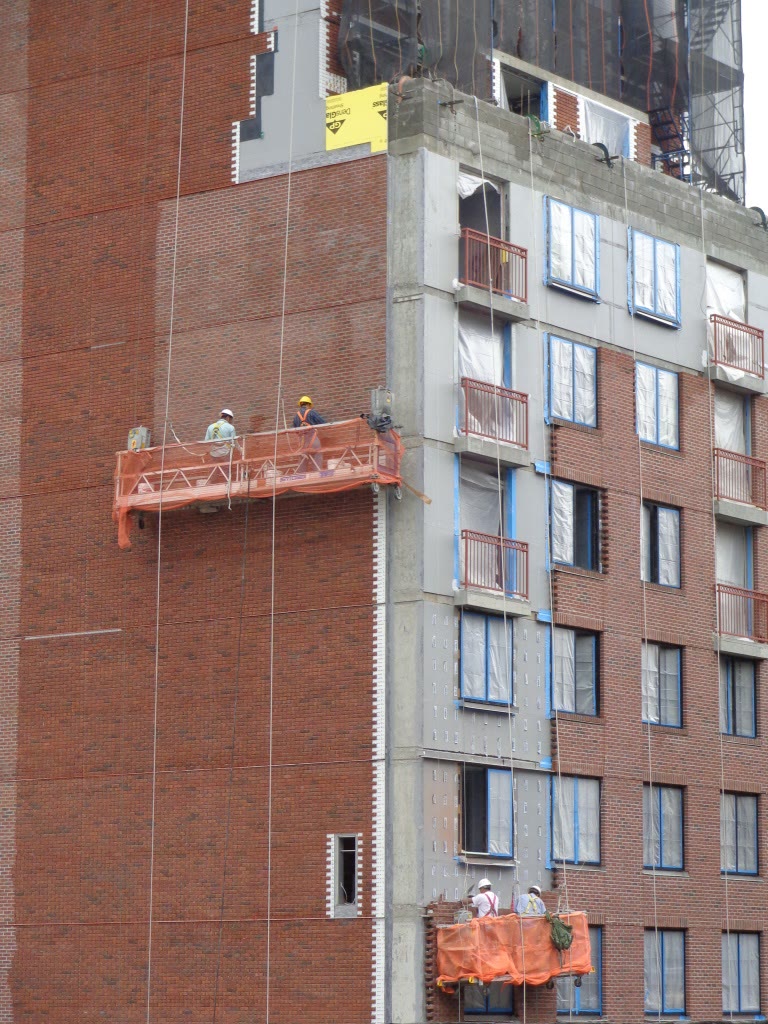
Brick isn't waterproof. It never was. A brick wall soaks up water every time it rains, and a well-built one either holds that water until it dries out or drains it back outside before it reaches the interior. When water shows up on your plaster, the brick is rarely the whole story. Something has let in more water than the wall was built to handle, or blocked the path it was supposed to take back out.
Leaks in brick buildings come from a fairly short list of places, but they rarely show up inside directly behind the spot where they got in. Water travels along steel, down cavities and across the tops of floor slabs before it finds a way out, and the stain on your ceiling can be several feet from the actual problem.
Know which kind of wall you have
Most New York brick buildings fall into one of two types, and they leak differently.
Prewar buildings usually have mass walls: solid brick, often 12 inches thick or more at the lower floors, several layers of brick bonded together with no gap. These walls handle rain by absorbing it and drying out. They leak when the mortar joints erode, when cracks give water a direct path through, or when something stops the wall from drying, such as a coating on the outside.
Most buildings from the 1950s on have cavity walls. The outer layer of brick is a veneer with an air space behind it and a backup wall of block or concrete. Water that gets past the brick is supposed to run down the back of the veneer, hit a strip of flashing at the bottom, and drain out through small weep holes. These walls leak when the flashing is missing, torn or badly lapped, or when the weeps and the bottom of the cavity are clogged with mortar droppings from the original construction.
If you don't know which one you have, the building's age is a good first guess, and your engineer or contractor can confirm it by looking at the brick pattern or removing a single brick.
Start with where the water shows up
Before anyone gets on a scaffold, write down where the water appears, when it appears, and what the weather was doing. That record will narrow the problem more than anything else.
Top-floor ceilings and the tops of top-floor walls
Suspect the parapet, the coping stones on top of it, or the roof flashing where the roof meets the wall. Parapets get weather on both faces, and the open joints between coping stones let rain run straight down into the core of the wall. On a lot of older buildings, roofers have coated the back of the parapet with tar, which traps water in the brick instead of stopping it. Our post on annual parapet inspections covers what to look for up there.
Above windows
Look at the lintels, the steel angles or stone beams that carry the brick over each window opening. Steel lintels need flashing over them to shed water out of the wall. On many older buildings that flashing is missing, or it stops short of the lintel's ends so water runs off the sides and into the wall. Once water reaches the steel, it rusts, and rust takes up several times the volume of the steel it came from. That growth pushes the brick up and out. The telltale sign outside is a horizontal crack along the top of the window opening, often with rust staining, or a stepped crack running diagonally up from the window corner.
Around window sides and below sills
This is often the cheapest problem to fix. The sealant between the window frame and the masonry dries out, shrinks and pulls away, usually faster on walls that get full sun. Sills cause trouble too. A stone sill that has cracked, settled so it slopes toward the building, or lost its drip edge on the underside will send water back into the wall instead of off it.
At each floor line, in newer buildings
On concrete-frame buildings from the 1960s and '70s, brick veneer is often supported at every floor by a steel shelf angle. Two things go wrong here. The flashing at the shelf angle fails. And many of these buildings were built without a soft joint, a compressible gap under each shelf angle that lets the brick expand while the concrete frame shrinks over the years. Without that gap, the brick gets squeezed, cracks and bulges, and water gets in along every floor line. If your leaks line up floor by floor, this is the first place to look.
Scattered leaks on one side, only in wind-driven rain
When the water shows up only during storms that come from a particular direction, the problem is usually the field of the wall itself: eroded mortar joints, cracked or spalled brick, and open joints around penetrations like air conditioner sleeves and pipes. In New York, nor'easters drive rain hard against north- and east-facing walls, and those elevations often wear out first.
Low on the wall in a cavity wall building
Water at the bottom of a cavity wall, often with white salt deposits on the outside near grade, points to blocked weeps or a cavity full of construction debris. The water is getting in higher up, which is normal, and then has nowhere to go.
Dampness with no rain
If the wall is wet in cold weather when it hasn't rained, consider condensation before you blame the facade. Warm, humid indoor air hitting a cold exterior wall will produce water on its own, especially in bathrooms and kitchens. A leak follows the weather. Condensation follows the thermostat.
What to look for from the outside
A pair of binoculars and a clear afternoon will show you a lot. Look for mortar joints recessed deep enough that you could fit a coin in them, and cracks, especially ones that step diagonally through the joints or run horizontally at lintels. Check for brick with the face popped off (spalling), rust stains running down from steel, and white powdery deposits called efflorescence, which are salts left behind as water evaporates from the wall. Efflorescence doesn't cause leaks, but it shows you exactly where water has been moving through the masonry. Photograph everything and note the date. It helps whoever you bring in, and it lets you see changes next year.
Confirm the source before you pay for the repair
When there's one obvious defect right above the leak, fixing it is the test. When there are several suspects, pay for a controlled water test first. A contractor or engineer wets one area at a time for a set period, starting low and working up, while someone inside watches for water. It takes a day or two and it prevents the most expensive outcome in leak repair, which is repointing an entire elevation and then watching the ceiling stain come back because the real problem was a lintel.
The fixes that work
Repointing. Eroded joints get raked out to a depth of about two to two and a half times the joint's width, usually around three quarters of an inch on standard brick, and refilled with mortar that's compatible with the brick. On old, soft brick that means a softer, lime-rich mortar. Hard modern mortar in an old wall forces moisture and movement through the brick instead of the joint, and the brick faces start popping off within a few winters. Typical NYC pricing runs $18 to $35 per square foot of wall, not counting scaffolding.
Lintel replacement with proper flashing. Rusted lintels get replaced with galvanized or stainless steel, with through-wall flashing above them that extends past the ends and turns up at each side (end dams), so water drains out of the wall instead of off the ends into it.
Parapet and coping repair. Minor problems mean repointing and resealing the coping joints. Parapets that lean or have cracked through are better rebuilt, with through-wall flashing under the new coping.
Window perimeter sealant. Old sealant gets cut out completely, the joint is cleaned, and new sealant goes in over a foam backer rod so it bonds on two sides and can stretch. Caulking over the old bead lasts one season.
Cavity and shelf angle repairs. Blocked weeps can sometimes be cleared from outside. More often, the brick at the bottom of the cavity or at each shelf angle has to be removed so the flashing can be replaced, and a soft joint cut in where there wasn't one.
The fixes that usually don't
Sealers and coatings. This is the one we're asked about most, and our answer is almost always no. A clear sealer doesn't close a cracked joint, a rusted lintel or a missing flashing, which is where most leaks come from. Film-forming coatings and paints are worse. They trap water that gets in through the defects you didn't fix, the brick can't dry, and when that water freezes the brick faces come off. A breathable silane or siloxane water repellent can be a reasonable last step on a wall that's already been properly repaired. It isn't a repair on its own.
Smearing mortar or caulk over the joints. Surface patching over eroded joints looks fine for a year. It doesn't bond to the old mortar behind it, and it cracks loose the first time the wall moves.
Fixing only the inside. New plaster and paint over a wet wall will need to be redone, and the water will keep working on the wall in the meantime.
Why a leak shouldn't wait
A leak is the wall telling you water is getting where it shouldn't. Inside the wall, that water rusts lintels and shelf angles and freezes in the brick every winter, and each cycle widens the path it came in through. The cracks, displaced brick and spalling that result are the same conditions a facade inspector classifies as SWARMP or Unsafe. On buildings taller than six stories, a leak you ignore this year can become a line item on your next FISP report, and a much bigger one than the original repair would have been. Our repair cost guide shows how quickly access costs change the math once a shed and scaffold are involved.
Timing matters as well. Mortar needs temperatures above about 40°F to cure properly, so exterior masonry repairs in New York run from spring through late fall. If you're seeing water now, get the diagnosis done this fall so the repair can start as soon as the weather allows.
Tell us where the water is coming in
NYC Superior Construction repairs brick walls, parapets, lintels and facades across New York City, Nassau, Westchester and Rockland counties, and Central and North New Jersey. Send us photos of the leak inside and the wall outside, along with when it happens, and we'll tell you what we think is going on and what it would take to fix it. See our masonry restoration work for the kinds of repairs we handle.
Frequently asked questions
Can water really leak through a brick wall?
Yes. Brick and mortar absorb water in every rainstorm. Walls are built to hold it and dry out, or to drain it back outside. Leaks happen when cracks, open joints or failed flashing let in more than the wall can handle, or when the drainage path is blocked.
Will a waterproof sealer stop the leak?
Usually not. Most leaks come through joints, cracks, parapets, lintels or flashing, and a sealer closes none of them. Film-forming coatings can trap water and cause spalling. A breathable repellent can help only after the real defects are repaired.
How do I find where the water is getting in?
Start with where and when it shows up. Top-floor leaks point to the parapet or roof. Leaks over windows point to lintels and flashing. Leaks during wind-driven rain on one side point to that wall's joints and brick. A controlled water test can confirm the source.
Is a leaking brick wall a Local Law 11 problem?
It can become one. Water in the wall rusts steel and freezes in the brick, producing the cracking and spalling that FISP inspectors classify as SWARMP or Unsafe.
This article is general information about masonry and building maintenance, not engineering advice. Every building is different, and persistent leaks should be evaluated by a qualified engineer or contractor. Last reviewed: September 22, 2026.