

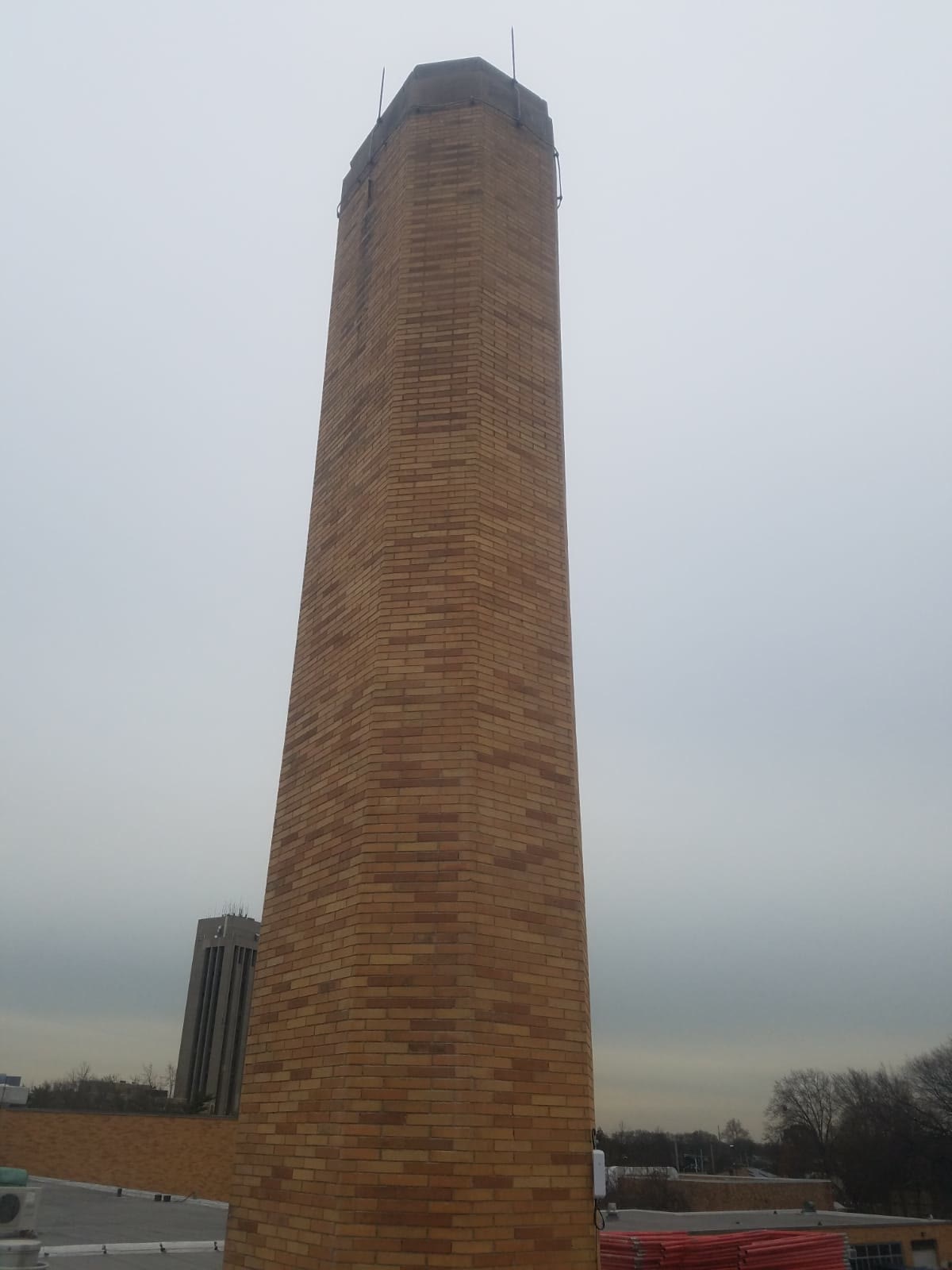
A stain spreading on the ceiling next to the chimney after every storm is one of the most common masonry calls we get. The good news is that most rain leaks around a chimney come from a short list of places, and the location and timing of the water usually point to the right one. The bad news is that the most common quick fix, a bead of caulk or a smear of roofing tar, rarely holds for more than a season.
Our post on chimney repair vs. rebuild covers the chimney as a whole and when it needs rebuilding. This one is about leaks: how to find the source, what each repair costs, and what doesn't work.
The usual suspects
Flashing. Where the chimney passes through the roof, metal flashing seals the joint. Properly done, it has two layers: step flashing woven into the roof shingles or membrane, and counterflashing set into a mortar joint cut into the brick and lapped down over the step flashing. On many chimneys, the counterflashing is just glued or caulked to the face of the brick, or the flashing has rusted, torn or been tarred over so many times that it no longer sheds water. Flashing is the most common cause of leaks right next to the chimney.
The crown. The concrete or mortar cap across the top of the chimney keeps water out of the top of the brick. Many crowns are just a thin, flat layer of mortar that cracks within a few years and lets water straight into the chimney.
The cap. Without a metal cap over the flue, rain falls straight down it. Water shows up in the fireplace, at the cleanout door, or as a rusted damper.
The brick and mortar. A chimney above the roof takes weather on all four sides. Worn mortar joints, spalled brick and cracks soak up wind-driven rain, and the water travels down inside the masonry until it reaches the roofline and finds a way in. Our spalling guide explains why brick faces pop off.
No cricket. A wide chimney sitting across the slope of a roof catches water and debris on its uphill side. A cricket (a small peaked roof behind the chimney) splits the flow around it. Wide chimneys without one tend to leak at the back.
Condensation, not rain. Some chimney "leaks" aren't rain at all. When flue gases cool inside an unlined or oversized flue, they condense into an acidic liquid that soaks through the masonry. It shows up in heating season whether or not it rains, often as dark, smelly staining or white deposits on the chimney walls inside the house.
Read the clues
| Where and when the water shows up | Most likely source |
|---|---|
| Ceiling or wall right next to the chimney, during or soon after rain | Flashing, or a missing cricket on the uphill side |
| In the fireplace, at the damper or cleanout | Missing or damaged cap, or a cracked crown |
| Only in wind-driven rain from one direction | Brick and mortar on that face of the chimney |
| A day or two after heavy rain, stains spreading down the chimney inside | Water absorbed by the crown or brick, working its way down |
| In heating season, rain or no rain, dark or smelly stains | Condensation in the flue |
| On the attic framing below the chimney | Flashing, crown or brick, often together |
Confirm before you pay
When there's one obvious defect, like a missing cap or a crown cracked through, fixing it is the test. When there are several suspects, a controlled water test sorts them out. Someone runs a hose on one area at a time for a set period while someone else watches inside, starting low at the flashing and working up the chimney, so you know which part is leaking before you pay to fix it. Our post on water leaking through brick walls describes the same approach for walls.
From the outside, with binoculars or from a ladder or the roof if it's safe to be there, look for:
- Counterflashing that's caulked to the brick face instead of set into a joint, or that's pulling away.
- Rust, holes or thick layers of tar on the flashing.
- Cracks in the crown, or a crown that doesn't overhang the brick.
- A missing cap, or one rusted through.
- Open mortar joints, spalled brick and white deposits on the chimney.
- A chimney that leans or has brick moving out of line, which is a bigger problem than a leak. Our rebuild guide covers it.
What the repairs cost
Planning ranges for a typical house chimney in the New York area. Prices in the city run toward the top of the ranges, and chimneys that need scaffolding, are very tall or serve apartment buildings and schools are priced separately.
| Repair | Typical range |
|---|---|
| Stainless steel chimney cap (single flue) | About $300 to $1,000 installed |
| Crown crack repair and sealing | About $300 to $800 |
| New cast concrete crown with drip edge | About $1,000 to $3,500 |
| New step flashing and counterflashing | About $800 to $2,500 |
| Cricket added behind a wide chimney | About $1,000 to $2,500 more |
| Repointing the chimney above the roof | About $1,000 to $4,000 |
| Rebuilding the chimney above the roofline | About $3,000 to $10,000+ |
| Stainless steel flue liner | About $2,500 to $7,000 |
| Breathable water repellent, after repairs | About $300 to $800 |
A leak often has more than one cause. A chimney with tarred flashing usually also has a cracked crown and worn joints, and fixing all three in one visit costs less than three separate trips.
Fixes that don't work
- Roofing tar or caulk on the flashing. It cracks as the roof and chimney move and weather, and every layer makes the proper repair harder.
- Counterflashing glued to the brick face. Water runs down the brick and behind it. Counterflashing belongs in a mortar joint cut into the brick.
- Film-forming sealers or paint on the brick. They trap moisture inside the chimney, which freezes and spalls the brick. If you use a repellent at all, it should be breathable, and only after the joints and brick are repaired.
- A new layer of mortar troweled over a cracked crown. Thin patches crack again within a winter or two.
- Waterproofing the outside to fix condensation. If the problem is in the flue, it needs a liner, not a sealer.
Don't let it go
A chimney leak does more damage than the ceiling stain shows. Water in the chimney freezes every winter and breaks down the mortar and brick from inside. Water in the roof framing rots wood and grows mold. And a leak that's been ignored long enough tends to turn a flashing job into a partial rebuild. Our freeze-thaw guide explains why fall is the time to fix it.
Chimney work on an active flue is easiest outside the heating season, and mortar needs temperatures of roughly 40°F and rising to cure, so late spring through early fall is ideal.
Chimneys on apartment buildings and schools
On larger buildings, chimneys and boiler stacks are often tall masonry structures that rise well above the roof. They need scaffolding, they can show up in facade inspections and Local Law 126 parapet observations, and their leaks often reach top-floor apartments or mechanical rooms. The same causes apply: flashing, crowns, caps, brick and condensation, at a larger scale. We repair and rebuild stacks on schools and apartment buildings as well as houses.
Send us photos of the chimney
NYC Superior Construction repairs leaking chimneys on houses, apartment buildings and schools across New York City, Nassau, Westchester and Rockland counties, and Central and North New Jersey. We'll find the source before we price the fix, and we'll do the flashing, crown and masonry in one visit when they all need it. Send us photos of the chimney from outside and of the leak inside, and tell us when the water shows up.
Frequently asked questions
Why does my chimney leak only when it rains?
Usually the flashing, the crown, a missing cap, or porous brick and open joints. Flashing is the most common.
How much does it cost to fix a leaking chimney?
Roughly a few hundred dollars for a cap, a few hundred to several thousand for the crown, about $800 to $2,500 for flashing, and more for repointing, rebuilds or liners.
Can water come through the brick of a chimney?
Yes. Worn joints, spalled brick and cracks let wind-driven rain in. Repointing and brick repair fix it.
Is it a leak or condensation?
If it happens in heating season regardless of rain, with dark or smelly stains, it's likely condensation. The fix is usually a properly sized liner.
Can I just seal the flashing with roofing tar or caulk?
Only briefly. Proper flashing uses step flashing and counterflashing set into a cut mortar joint.
This article is general information. Prices are planning ranges for typical house chimneys in the New York area, not quotes. Larger building and institutional chimneys are priced differently. Have a qualified contractor or chimney professional inspect before you commit to a repair. Last reviewed: October 4, 2026.