

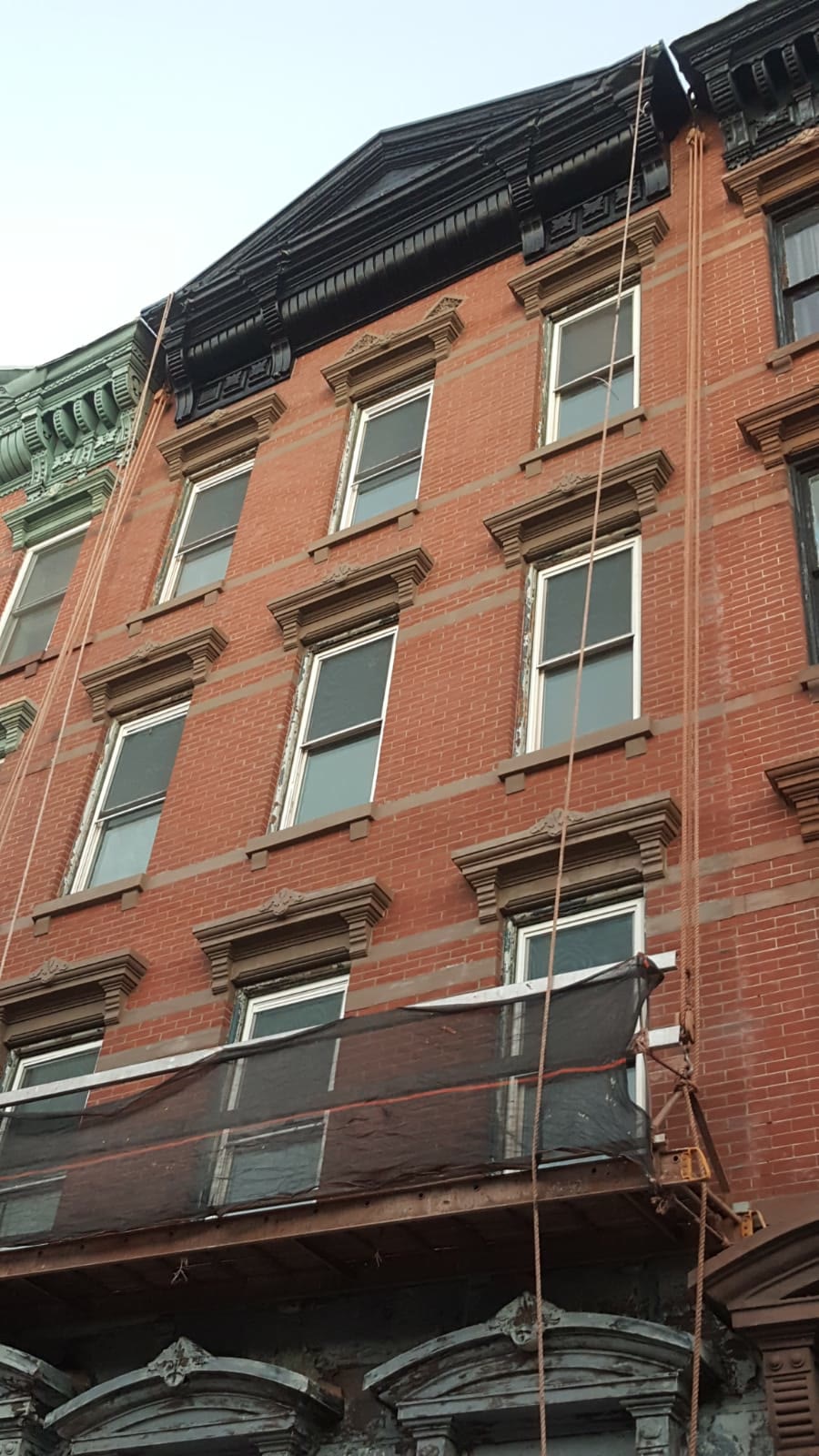
Almost every brick building in New York has cracks. Brick and mortar are stiff and brittle, and buildings move: they heat up and cool down, get wet and dry out, settle a little, and carry steel that rusts. Most of the cracks that result are harmless apart from the water they let in. A few are the first visible sign that part of the wall, or the building under it, is moving in a way it shouldn't.
You can't always tell which is which from the sidewalk. But the shape, location, width and behavior of a crack tell you a lot, and knowing how to read them helps you decide whether you need an engineer or just a pencil and a calendar.
First, where does the crack run?
A crack that follows the mortar joints, stepping around the bricks, means the mortar was the weakest part of the wall, which is how a wall is supposed to crack. A crack that runs straight through the bricks themselves means the force was strong enough, or sudden enough, to break the units. Cracks through brick aren't automatically structural, but they tell you more force was involved, and they deserve a closer look.
Then look at the two sides of the crack. If the brick on one side sits further out than the brick on the other, or has dropped relative to it, the wall has moved, not just cracked. Displacement like that is the single most important thing to notice, and it's a reason to call an engineer regardless of how thin the crack looks.
Step cracks
Step cracks (also called stair-step cracks) zigzag diagonally through the mortar joints. They're the most common crack in brick buildings, and the cause depends mostly on where they start.
From the corner of a window or door. This is usually local. The most common cause in older New York buildings is a rusting steel lintel. As the steel corrodes it expands, lifting the brick above it, and the crack runs diagonally up from the end of the lintel. You'll often see rust staining or a horizontal crack along the top of the opening as well. Openings also concentrate stress, so minor movement anywhere in the wall tends to show up at window corners first.
Across a large part of the wall, or near the bottom. Step cracks that run long distances, get wider toward one end, or appear low on the wall near a corner can point to settlement: one part of the foundation moving down relative to the rest. In New York that's commonly linked to leaking water or sewer lines softening the soil, old foundations on poor fill, or excavation for construction next door. Settlement cracks tend to be wider at one end than the other, because one part of the wall is rotating away from the rest. That taper is worth measuring.
Short, thin and scattered. Small step cracks spread around a wall with no pattern and no displacement are usually from shrinkage and normal movement. They need repointing so water can't get in, and not much else.
Vertical cracks
Vertical cracks run straight up the wall. Some follow the vertical mortar joints and break through every other brick. Others cut cleanly through everything in their path.
The most common cause is expansion. Fired clay brick absorbs moisture from the air after it leaves the kiln and grows very slightly for years, and it expands and contracts with temperature every day. Over a long, uninterrupted wall that movement adds up. Newer brick walls are supposed to have vertical expansion joints, filled with sealant instead of mortar, to absorb it. Where they were left out or spaced too far apart, the wall makes its own joints, usually near building corners, at the ends of long walls, or at changes in wall height. These cracks are often roughly even in width from top to bottom and may open and close a little with the seasons.
Vertical cracks can also come from settlement at one end of a wall, from a wall that has separated from a perpendicular wall it was supposed to be tied into, or from heavy loads concentrated over narrow piers between windows. A vertical crack that's wider at the top or bottom, or where the wall on either side no longer lines up, points to movement rather than expansion.
Horizontal cracks
Horizontal cracks in above-ground brick walls usually come from something pushing or lifting the brick, and they're the ones we take most seriously.
Along window heads. Rusting lintels, as above.
At each floor line in a concrete-frame building. Many buildings from the 1960s and '70s have brick veneer resting on steel shelf angles at every floor, and many were built without a soft joint under those angles. As the concrete frame shortens slightly over time and the brick expands, the brick gets squeezed between floors. It cracks horizontally, then bulges. This can produce loose brick high on a building, and it's a common FISP finding.
At the base of a parapet. A roof slab expands in the sun and can push the parapet outward, opening a horizontal crack right at roof level. A parapet cracked through at its base is only held by its own weight. See our guide to annual parapet inspections.
Repeating at regular intervals up the wall. In cavity walls, the brick veneer is attached to the backup wall with metal ties embedded in the mortar joints. If those ties corrode, they can expand and crack the joints they sit in, producing horizontal cracks at a regular vertical spacing. Corroded ties also mean the veneer isn't properly attached, which is a real safety issue on a tall building.
How wide is too wide?
Engineers often use a damage scale developed by the UK's Building Research Establishment, which grades cracks by width and by how much repair they need. A simplified version:
| Crack width | Typical category | What it usually means |
|---|---|---|
| Hairline to about 1/32" | Negligible to very slight | Usually cosmetic. Repoint if water can get in. |
| Up to about 3/16" | Slight | Repair needed. Find the cause before filling. |
| About 3/16" to 5/8" | Moderate | Needs an engineer. Brick replacement or rebuilding of sections likely. |
| Over 5/8" | Severe to very severe | Structural repair. Get an engineer out promptly. |
We'd be more cautious than the table on a tall building. Our rule of thumb is that anything around 1/8 inch or wider on an upper floor should be looked at by an engineer, because a piece of brick doesn't need to be large to hurt someone on the sidewalk.
Width also isn't the whole story. A 1/16-inch crack that's growing every month is more worrying than a 1/4-inch crack that's been the same size for 30 years. So is any crack with displacement, bulging or brick that sounds hollow when tapped.
Watch it before you fix it
Most of the questions that matter about a crack come down to whether it's still moving. The cheap way to find out is to mark both ends of the crack with a pencil line, write the date next to each mark, and photograph it with a ruler held across the widest point. Check it every month or two. A plastic crack monitor (a small two-piece gauge screwed across the crack) costs little and measures changes to a fraction of a millimeter.
Give it through at least one full change of season if you can. Cracks from thermal movement open in winter and close in summer, then repeat. Cracks from settlement or corroding steel just keep getting wider. That difference usually decides the repair.
If construction is about to start next door, especially excavation, photograph and date every crack on the adjacent walls before work begins. It's much easier to show damage was caused by the neighbor's project when you can prove what was there beforehand.
When to call an engineer right away
Don't wait on monitoring if you see any of these: brick on one side of a crack sitting out of line with the other; a wall section bulging or leaning; cracks that appeared suddenly or are widening noticeably from week to week; doors and windows that have started sticking along with new cracks; or loose, displaced brick or stone above a sidewalk. If something looks ready to fall onto a public way, protect the area and call 311.
How cracks get fixed
The repair depends entirely on the cause, which is why it matters so much to diagnose first.
Thin cracks from movement that has stopped get repointed with mortar that matches the existing joints. Cracks through brick usually mean replacing the damaged brick.
Where a crack is stable but wide, or keeps reopening from minor movement, it can be stitched. The mason cuts slots into the bed joints across the crack and embeds stainless steel helical bars in grout, which ties the two sides of the wall back together without rebuilding it.
Cracks from expansion won't stay closed if you fill them with mortar, because the wall is still trying to move. The fix is to cut in proper expansion joints nearby, filled with sealant, and then repair the existing crack. For cracks from rusting steel, the steel has to be exposed and replaced, whether it's a lintel, a shelf angle or wall ties. Patching over it only hides the problem while it gets worse.
Settlement is an engineer's call. Sometimes the movement has stopped and the wall only needs repair. Sometimes the cause (often a leaking pipe) needs to be fixed first, and in more serious cases the foundation needs to be reinforced before any masonry work makes sense.
What not to do: squeeze caulk into the crack and call it fixed. It hides the crack from the next person who looks while water keeps working behind it, and you lose the one clue that tells you whether the wall is still moving.
Cracks and your facade inspection
On buildings taller than six stories, cracks are exactly what a FISP inspector is looking for. Minor cracking usually lands in a SWARMP report as something to repair before the next cycle. Cracks with displacement, bulging or loose material are classified Unsafe, which means a sidewalk shed and a 90-day repair clock. Our guides on SWARMP reports and the Cycle 10 deadlines explain what each classification requires. If water is coming in through the cracks, our post on brick wall leaks covers tracing it.
Have someone look at the crack
NYC Superior Construction repairs cracked brick, lintels, parapets and facades across New York City, Nassau, Westchester and Rockland counties, and Central and North New Jersey. Send us photos of the crack, with a ruler in the shot and a note on how long it's been there, and we'll tell you what we think is going on. If it looks structural, we'll tell you that too, and that you need an engineer before you need a contractor. See our masonry restoration work for the repairs we handle.
Frequently asked questions
Are step cracks in a brick wall serious?
It depends on width, whether the crack is growing, and whether the brick has shifted out of line. A thin step crack from a window corner is often a rusting lintel. A wide, tapered or growing step crack across a large part of the wall can mean foundation movement and needs an engineer.
What causes vertical cracks in brick?
Most often expansion. Brick grows slightly over its life and moves with temperature, and long walls without expansion joints crack vertically, usually near corners. Settlement and poorly tied intersecting walls can also cause them.
How wide does a crack have to be before I worry?
Hairline cracks under about 1/32 inch are usually cosmetic. On a tall building, we'd have an engineer look at anything around 1/8 inch or wider, anything growing, and any crack with displacement.
Can I just fill the crack with mortar or caulk?
Only after the cause is dealt with. If the wall is still moving, mortar will crack again, and caulk will just hide the problem while water gets in behind it.
This article is general information, not engineering advice. Cracks can't be reliably diagnosed from a description or a photo, and any crack you're concerned about should be assessed in person by a licensed engineer. Last reviewed: September 22, 2026.