

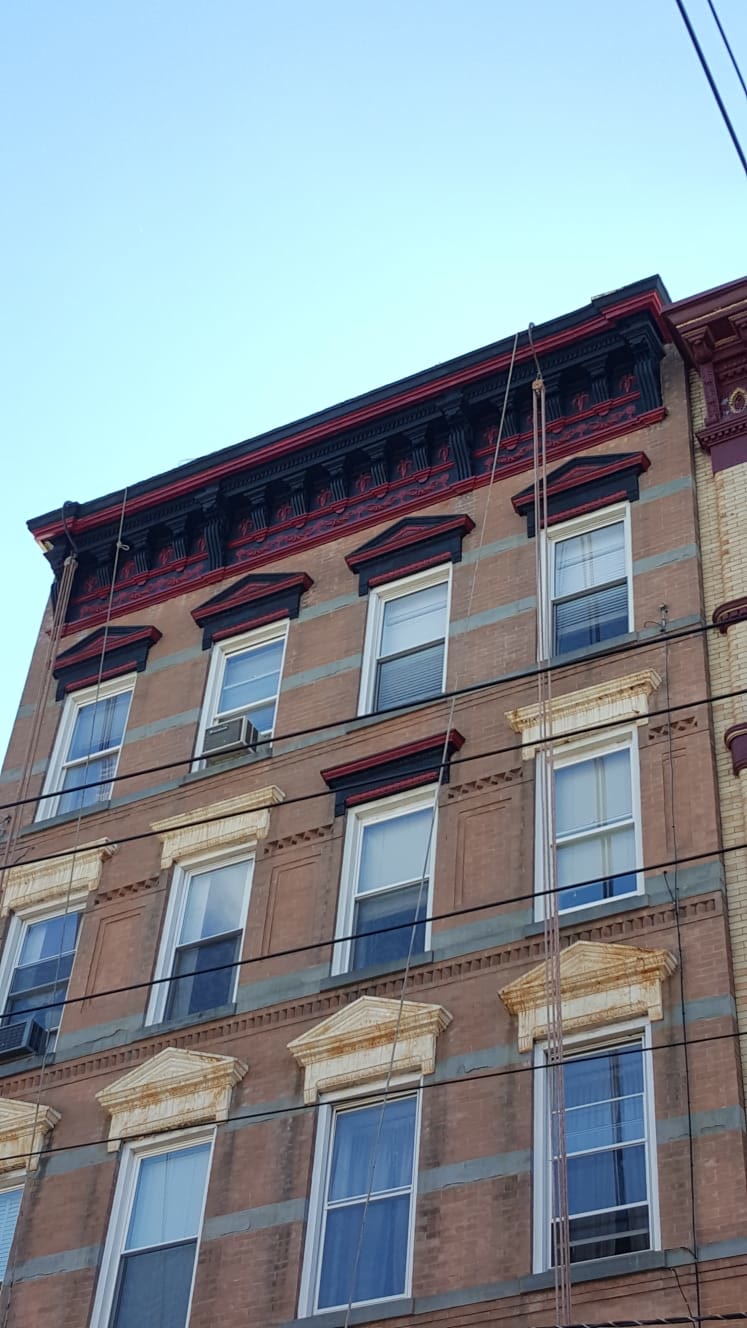
Look up at almost any older brick building in New York and you'll find cracks running across the tops of some windows. Most of the time, the cause is the lintel: the steel or stone beam that carries the brick over the opening. When steel lintels rust, they expand and push the brick above them out of place. It's one of the most common items on Local Law 11 reports, and one of the most common reasons owners call us.
This guide covers what lintel replacement costs in New York City, what drives the number, what a proper replacement involves, and how to compare bids so you're paying for the same work.
What a lintel is and why it fails
On most brick buildings in the city, the lintel over each window is a steel angle (an L-shaped piece of steel) sitting on the brick at each side of the opening, with the outer layer of brick resting on it. Older buildings and brownstones often have stone lintels instead, and some newer buildings use precast concrete.
Steel lintels fail because water gets to them. Mortar joints wear, flashing was never installed or has failed, and water runs down inside the wall and sits on the steel. Rust takes up several times the volume of the steel it replaces, so as the lintel corrodes, it grows. That growth lifts the brick above it, cracks the joints, and pushes the face of the wall outward. Each winter, water in those cracks freezes and opens them further.
Signs that a lintel is going:
- A horizontal crack along the top of the window, often with the brick above it slightly out of line.
- Diagonal step cracks running up and out from the top corners of the opening.
- Brick above the window bowing out or sagging.
- Rust stains running down the brick from the window head.
- Visible steel that is flaking in layers.
- A widening gap between the top of the window frame and the brick, or a window that has started to stick.
Our posts on reading cracks in brick walls and spalling brick show how lintel damage looks compared with other causes.
What it costs
The table shows typical New York City ranges for the lintel work itself. Access (scaffolding, swing stages or a sidewalk shed), engineering and permits are usually separate lines.
| Work | Typical range | Notes |
|---|---|---|
| Steel lintel replacement, standard window opening | $1,200 to $3,000 each | On a facade job with access in place. Includes brick removal and rebuilding, new steel, flashing and repointing. |
| Wide openings (double windows, storefronts, garage doors) | $3,000 and up each | Heavier steel, more brick to remove, often temporary shoring. Usually priced one by one. |
| Stone or cast stone lintel replacement | Often several thousand dollars each | Driven by fabrication. Custom stone takes weeks to months to make. |
| Expose, clean, prime and flash in place | A fraction of replacement | Only when the steel still has its full thickness. |
A single lintel on a house costs more per opening than one lintel among twenty on an apartment building, because the setup, scaffold and minimum crew time are spread over less work. On the other end, a facade job with forty lintels on one elevation gets a better unit price because the crew moves steadily from one opening to the next.
For how lintel prices fit into a full facade budget, see our Local Law 11 cost guide, which works through a sample building with twelve lintels.
What drives the price
Span. A wider opening needs a heavier steel angle and longer bearing on each side, and more brick comes out above it.
How much brick has to come out. To replace a lintel, the crew removes the brick sitting on it, usually several courses in a triangle or rectangle over the opening, depending on the bond and how far the damage goes. Badly displaced brick above the window means a bigger rebuild.
Shoring. When the brick above can't support itself during the work, the crew installs temporary supports. That's common on wide openings and on lintels near floor lines or other loads.
Steel and finish. Hot-dip galvanized steel is the usual minimum. Stainless steel costs more and lasts longer, and engineers specify it in very wet spots or where the repair would be hard to reach again.
Brick matching. Rebuilding the area above the window means matching the existing brick and mortar color. Salvaged brick is reused where it's sound. Where it isn't, finding a match can add cost and lead time.
The inside of the wall. On some buildings the lintel supports only the outer layer of brick. On others, the work reaches the interior, so window trim, plaster or drywall has to be opened and restored. Ask whether the price includes interior work.
The window. Sometimes the window has to come out, or its perimeter sealant has to be redone afterward.
Access. Lintels on the second floor of a house can sometimes be reached from a small scaffold. Lintels on the ninth floor need a swing stage, a pipe scaffold or a mast climber, and usually a sidewalk shed. On small jobs, access can cost as much as the lintels.
Engineering, permits and landmarks. Lintel replacement is structural. On most multi-family and larger buildings, it's done under a DOB permit with drawings from an engineer. On a landmarked building, LPC approves the materials and details. Our LPC guide explains how that works.
How a proper replacement is done
- Protect the window and the area below, and install shoring if needed.
- Remove the brick above the lintel, setting aside sound brick for reuse.
- Remove the old steel completely.
- Install the new lintel, galvanized or stainless and sized by the engineer, with full bearing into the brick at each side.
- Install through-wall flashing above the lintel, extending past both ends and turned up at the ends (end dams), so water that gets into the wall drains out instead of sitting on the new steel.
- Leave weep openings at the lintel so the flashing can drain.
- Rebuild the brick with matching brick and mortar, and leave a sealant joint between the lintel and the window frame where the detail calls for it.
- Repoint the surrounding joints and clean the wall.
The flashing matters as much as the steel. A new lintel installed without it will rust again, just more slowly. Our post on water leaking through brick walls explains why.
Cheap fixes that don't last
- Caulking the crack. It looks fine for a season. The steel keeps rusting and keeps pushing.
- Painting the exposed edge of the lintel. Only the front edge gets paint. The rust is on the part buried in the wall.
- Repointing over it. New mortar in a joint that's being pushed open by rusting steel cracks again quickly.
- Replacing the steel without flashing. Better than nothing, but it sets up the same failure for later.
Lintels and your facade inspection
Rusted lintels and the cracking they cause show up constantly in FISP reports, usually as SWARMP conditions, and as Unsafe once brick has displaced. A lintel flagged SWARMP in one cycle and still there at the next inspection has to be filed as Unsafe. If your report lists lintels, they're usually worth doing sooner rather than later, because they get more expensive each winter. Our posts on SWARMP reports and Local Law 11 repair timelines cover the deadlines and scheduling.
Questions to ask before you compare bids
- Is the price per lintel, and what's the unit price for additional lintels found once the scaffold is up?
- Galvanized or stainless steel, and what size?
- Does the price include through-wall flashing with end dams and weeps?
- How much brick will come out above each opening, and will sound brick be reused?
- Is shoring included where needed?
- Is any interior work included, and who restores the finishes?
- Does the price include repointing the surrounding area and sealing the window perimeter?
- Who files the permit, and is the engineer's inspection included?
Two bids at $1,500 and $2,500 per lintel may describe very different jobs. The answers to those questions usually explain the gap.
Get a lintel price you can compare
NYC Superior Construction replaces steel and stone lintels on apartment buildings, co-ops, schools, mixed-use buildings and houses across New York City, Nassau, Westchester and Rockland counties, and Central and North New Jersey. We price lintels per opening with a unit rate for extras, include flashing as standard, and work from your engineer's details. Send us your facade report or a few photos of the cracked window heads, and we'll give you a realistic number.
Frequently asked questions
How much does it cost to replace a steel lintel in NYC?
About $1,200 to $3,000 per standard window opening when access is already in place. Access, engineering and permits are extra.
How do I know if my lintels need to be replaced?
Horizontal cracks at the window head, step cracks from the corners, bowed or sagging brick, rust stains, and a gap opening above the window frame.
Can a rusted lintel be repaired instead of replaced?
Only when the rust is on the surface and the steel is still full thickness. Once it has lost section or moved the brick, it needs replacing.
Do I need a permit to replace lintels in NYC?
Usually, on multi-family and larger buildings, under a DOB permit with an engineer's drawings. Landmarked buildings also need LPC approval.
Should replacement lintels be galvanized or stainless steel?
At least hot-dip galvanized. Stainless costs more and lasts longer in wet or hard-to-reach spots. Flashing above it matters just as much.
This article is general information. Prices are typical New York City ranges for planning purposes, not quotes, and they change with the market. Every building is different, so get a scope from an engineer and priced bids before budgeting. Last reviewed: October 4, 2026.