
After a facade report comes back, boards ask two questions: how much will this cost, and how long will it take. Our Local Law 11 cost guide answers the first. This post is about the second, which matters just as much. The schedule decides how long the sidewalk shed stays up, which season the masons end up working in, and whether the building makes its filing deadline.
For a typical mid-size building with a SWARMP report, expect roughly 9 to 15 months from the day the report arrives to the day the shed comes down. The masonry itself is usually the shortest part, often two to four months. Most of the calendar goes to the steps before anyone touches a brick, and those are the steps an owner controls.
The phases at a glance
| Phase | Typical time | Can run alongside |
|---|---|---|
| Close-up inspection and report filing | 1 to 3 months | Early budgeting, neighbor outreach |
| Repair design and construction documents | 1 to 3 months | Board budget discussion |
| Bidding and contractor selection | 1 to 2 months | Financing |
| Board approval and financing | 1 to 3 months | Design and bidding |
| Contract, insurance and permits | 3 to 8 weeks | Material orders |
| Access setup (shed, scaffold, rigging) | 1 to 3 weeks | Final material deliveries |
| Repair work | 6 weeks to 6 months | Rolling engineer inspections |
| Sign-off, amended filing, shed removal | 2 to 6 weeks | Punch list |
Add up the middle column end to end and you get well over a year. Buildings that finish faster do it by running phases side by side, which is what the right-hand column is for.
Phase 1: The inspection and the report
Your Qualified Exterior Wall Inspector (QEWI) has to examine every street-facing facade up close, with drops no more than 60 feet apart, from a scaffold, swing stage or rope access. That work depends on rigging, roof access, calm weather and sometimes permission from the building next door. Once the close-up work is done, the report has to be filed in DOB NOW: Safety within 60 days.
From hiring the QEWI to a filed report usually takes one to three months. It runs longer late in a sub-cycle, when every building in the group is calling the same firms. Our post on FISP Cycle 10 deadlines lists the filing windows.
One way to save a month: ask your QEWI for the list of conditions and rough quantities as soon as the drops are finished. You don't have to wait for the filed report to start designing repairs or to give the board a budget range.
Phase 2: Turning the report into repair documents
A FISP report tells you what's wrong and where. It is not a set of repair instructions. Before contractors can price the job properly, an engineer or architect has to turn it into drawings and specifications: which repairs go where, estimated quantities for each item, and details for lintels, flashing, parapets and anything structural.
A small scope of repointing and spot brick replacement can be documented in a few weeks. A larger job with parapet reconstruction, lintel replacement across several elevations, or terra cotta work can take two to three months. On a landmarked building, add the Landmarks Preservation Commission review, which often includes mortar samples or a test panel. Our LPC approval guide explains how to keep that review at staff level, which is much faster than a public hearing.
Phase 3: Bidding
A proper bid process with three to five contractors takes four to eight weeks: a site walk, two to three weeks for contractors to price the documents, a round of questions, then a week or two to level the bids and interview the finalists. Compressing it rarely saves time overall. Rushed bids miss things, and missed scope comes back later as change orders and schedule delays. Our guide on choosing a masonry contractor covers what to check.
Ask every bidder for a schedule along with the price: how they will access each wall, how many crews and rigs they plan to use, and how long they expect each elevation to take. Two bids at the same price can have very different shed bills attached.
Phase 4: Board approval and financing
This is the phase with the widest range, and it is almost entirely in the owner's hands. A board with funded reserves that votes at its next meeting can move in a few weeks. A special assessment that needs shareholder or unit-owner notice, or a loan that needs lender approval, can take three months or more.
The most common delay we see is a board that waits for hard bids before it starts talking about money. That adds a month or two before the vote can even happen. Put a budget range in front of the board while the engineer is still designing, so the financing work runs in parallel with the bidding instead of after it.
Phase 5: Contract, insurance and permits
Once the contractor is chosen, the contract goes to the building's attorney, insurance certificates go to the broker, and the permit filings start. The design professional files the work permit for the facade repairs in DOB NOW: Build. The sidewalk shed and any suspended or supported scaffold need their own permits. A clean filing is often approved within a few weeks. Each round of DOB objections adds time.
Neighbor access can turn into the longest item on the list. If the work needs the roof or yard of the building next door for rigging or protection, you need a license agreement with that owner. When a neighbor refuses, New York law lets you petition a court for access under RPAPL Section 881, but that process takes months. Send the access request during design, not after the contract is signed.
Material lead times also start here. Standard steel lintels can usually be fabricated in a couple of weeks. Brick matched to an older facade can take six to twelve weeks, and custom terra cotta or cast stone can take several months. Order long-lead materials as soon as the contract is signed.
Phase 6: Getting access up
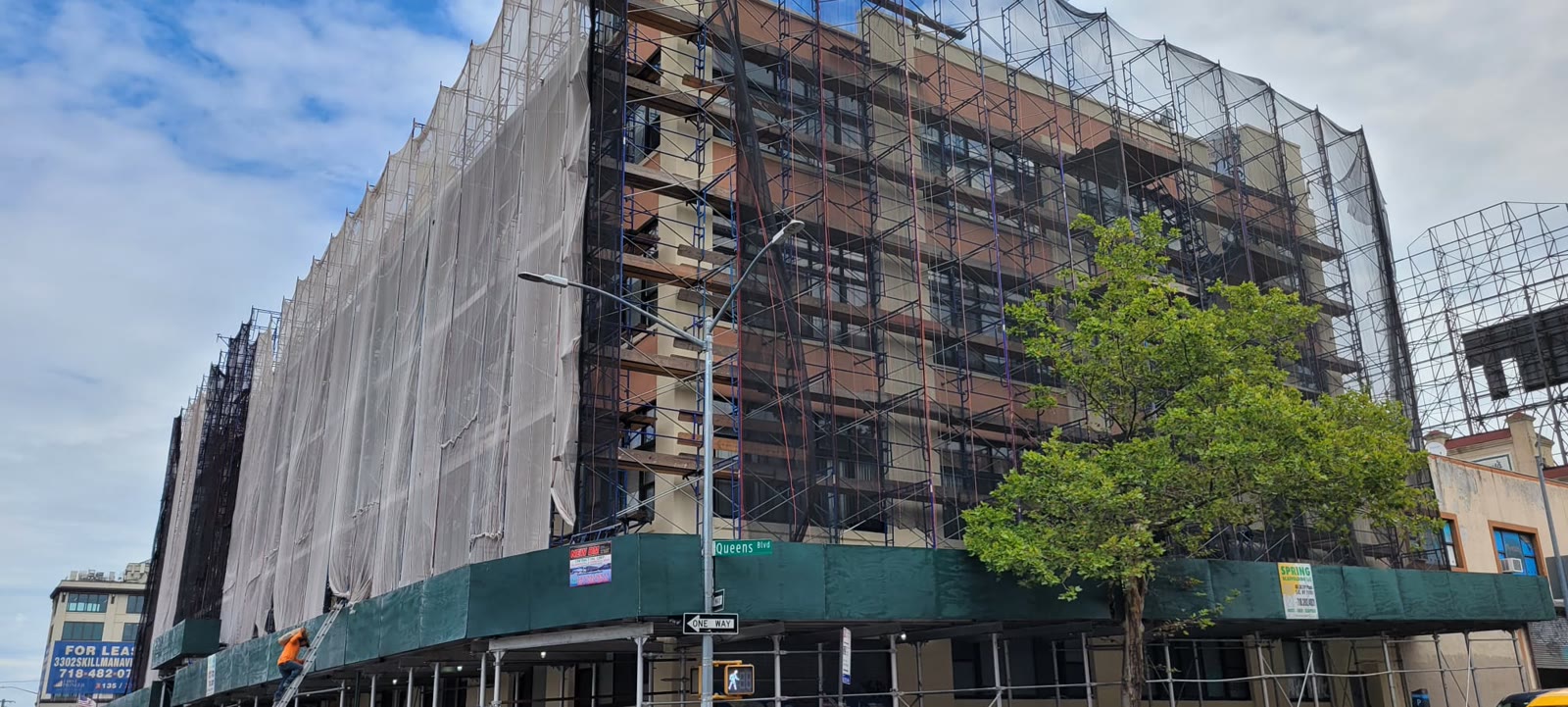
A sidewalk shed along a typical frontage goes up in a few days to two weeks. Pipe scaffolding on a full elevation takes one to three weeks. Swing stages can be rigged in days once the roof anchorage or outriggers are approved. The access method is usually set by the engineer's documents and the contractor's plan, and it drives both the cost and the pace of the work that follows.
Phase 7: The repair work
Construction time depends on the scope, the number of crews and rigs on the building, and the weather. Some rough ranges from the kinds of jobs we do:
- Spot repointing and a handful of lintels on one street elevation of an eight-story building: about 4 to 8 weeks.
- Full repointing and brick replacement on two elevations of a twelve-story co-op: about 3 to 5 months.
- A parapet rebuild along a 100-foot frontage: about 3 to 6 weeks on its own, longer if new coping stone has to be fabricated.
- Cornice, terra cotta or other ornamental replacement: often set by fabrication time more than by installation.
Plan for the scope to grow once the scaffold is up. Close-up, the crew always finds more loose brick and more rusted steel than anyone could see from the sidewalk. Unit prices handle the money side of that. On the schedule side, we suggest adding 15 to 20 percent to the contractor's construction estimate when you plan shed rental and resident notices.
Weather matters more than most boards expect. Mortar needs temperatures of roughly 40°F and rising to cure properly. Repointing stops in rain, and swing stages come down in high wind. In New York, the productive season for exterior masonry runs from about April through November. Winter work is possible with heated enclosures, but it costs more and moves slower. A job that starts in late October can easily stop for the winter and finish in April.
Phase 8: Close-out
When the work is done, your QEWI or the design professional inspects it. For conditions that were filed as Unsafe, the amended report has to be filed within two weeks of the correction. The work permit gets signed off, the shed comes down (usually in a few days), and the contractor finishes the punch list before the retainage is released. Allow two to six weeks for this phase, and don't let it drift. A finished repair with a shed still standing keeps costing rent every month.
A worked example
Take a twelve-story, 70-unit co-op in sub-cycle 10B. Its report comes back SWARMP in November 2026, calling for repointing, about 300 replacement brick, 14 steel lintels and a coping reset on the front and one side elevation. A well-run schedule looks like this:
| When | What happens |
|---|---|
| November to December 2026 | Engineer prepares repair documents. Board sees a budget range at its December meeting. |
| January 2027 | Bids go out, contractors walk the site, the neighbor access letter is sent. |
| February 2027 | Bids come in, get leveled, and two finalists are interviewed. |
| March 2027 | Board approves the contract and the assessment. |
| April 2027 | Permits issued, lintels fabricated, matching brick ordered. |
| Early May 2027 | Shed and swing stages go up. |
| May to August 2027 | Masonry work on both elevations. |
| September 2027 | Engineer sign-off, permit closed, shed down. |
That's about ten months from report to sidewalk, with four months of construction. Now suppose the board tables the March vote until June. The work starts in July instead of May, runs into November, and may hit the first cold snap before it's done. Total time grows to 14 to 17 months, and the masonry didn't change at all. Only the decision date did.
Unsafe conditions run on a different clock
If the report classifies any condition as Unsafe, public protection (usually a sidewalk shed) goes up right away, and the condition has to be corrected within 90 days of the filing unless DOB grants an extension. Under Local Law 51, the shed permit also starts its own milestones: complete construction documents within 5 months, an acceptable work permit application within 8 months, and finished repairs within 2 years, with penalties of $5,000 to $20,000 for each one missed. Our sidewalk shed guide covers those rules in detail.
In practice, 90 days is enough for a small, contained repair. For anything larger, owners request an extension, and DOB wants to see progress: documents underway, a contractor under contract, permits filed. Running the phases above in parallel matters most here, because every week of delay comes with shed rent and penalty exposure.
What stretches a schedule
- Waiting for hard bids before starting the financing conversation.
- A neighbor who won't sign an access agreement.
- Landmark review that starts after the design is finished instead of during it.
- Scope that grows once the scaffold is up, with no allowance for it in the schedule.
- Custom brick, stone or terra cotta ordered late.
- Missing the warm season by a month and losing the winter.
- A contractor spread across too many jobs. Ask how many crews will be on your building and whether they'll be there every working day.
How to shorten it
- Start the repair design as soon as the close-up drops are done.
- Give the board a budget range within a few weeks of the report, using typical unit prices.
- Send neighbor access requests during design.
- Book your QEWI and contractor early in your sub-cycle window, before the rush.
- Order long-lead materials the day the contract is signed.
- Do the full scope in one mobilization when the budget allows. Setting up access twice costs time as well as money.
- Aim the construction at spring through fall.
- Have the annual Local Law 126 parapet observation done during the same visit, so parapet repairs land in the same job.
Get a schedule along with your price
When NYC Superior Construction prices a facade repair, we give the board a schedule along with the number: when access goes up, how many rigs and crews we'll put on the building, how long each elevation should take, and when the shed comes down. We've completed 34 facade projects over 20+ years across New York City, Nassau, Westchester and Rockland counties, and Central and North New Jersey, with $700,000 bonding capacity per project. Send us your FISP report and we'll come back with a realistic scope, budget range and timeline, free and with no obligation. More about the work is on our Local Law 11 page.
Frequently asked questions
How long does a Local Law 11 repair project take?
For a mid-size building with SWARMP conditions, plan on roughly 9 to 15 months from report to shed removal. The masonry work itself is usually 6 weeks to 6 months.
How long do we have to fix Unsafe facade conditions?
90 days from filing unless DOB grants an extension. The shed milestones under Local Law 51 (5 months, 8 months and 2 years from the shed permit) apply too.
Can facade repairs be done in the winter in NYC?
Some can, with heated enclosures and cold-weather practices that add cost. Most owners schedule the bulk of the work between April and November.
How long will the sidewalk shed stay up during repairs?
For SWARMP work, roughly the length of construction plus close-out. For Unsafe conditions, from the filing until the repair is done and the amended report is in.
Does landmark status add time to a facade repair?
Usually. LPC approval, including samples or a test panel, comes before the DOB work permit. Start the application during design.
This article is general information about New York City building regulations, not legal or engineering advice. Durations vary with the building, the scope and the weather, and rules change, so confirm current requirements with the NYC Department of Buildings or your QEWI. Last reviewed: October 4, 2026.