
If you've collected a few estimates for brick work, you've probably seen the same job called repointing by one contractor, tuckpointing by another and just "pointing" by a third. In New York, most of them mean the same thing. Strictly speaking, though, repointing and tuckpointing are different techniques, and the difference matters if you own an older building or one that's landmarked.
What repointing is
Repointing is the repair. The mason removes deteriorated mortar from the joints between the bricks, down to a set depth, and replaces it with new mortar. That's it. When a facade report, an engineer or a contractor says your wall needs pointing work, this is almost always what they mean.
Mortar is supposed to wear out before the brick does. It's softer and more porous on purpose, so that water, salts and movement work through the joints instead of the brick. After a few decades of rain and freeze-thaw cycles, the joints erode, crack and pull away from the brick. Repointing replaces them before the damage spreads to the brick.
What tuckpointing is
Tuckpointing is a decorative finish that dates back to 18th-century England. The mason fills the joints with mortar tinted to match the color of the brick, then cuts a narrow groove down the middle of each joint and presses in a thin, raised line of contrasting mortar, traditionally white lime putty. From the street, the wall looks like it was built with perfectly uniform brick and very fine, crisp joints, even when the real joints are wide and uneven.
It's a two-step, slow, skilled process, and it costs noticeably more than standard repointing. Some 19th-century buildings in New York and other American cities were finished this way, and on those buildings, a proper repair means recreating it.
In much of the U.S., though, "tuckpointing" has become the everyday name for ordinary repointing. So when a contractor quotes you tuckpointing, ask what they'll actually do. Usually the answer is repointing.
Which one your building needs
Almost certainly repointing. The exception is a building that was originally tuckpointed, which you can usually spot in protected areas such as under cornices or behind downspouts, where you may still find traces of the thin raised lines. If your building is in a historic district or is an individual landmark and shows that original finish, LPC will expect the repair to match it. Our post on landmark facade repairs covers what the Landmarks Preservation Commission asks for.
For everyone else, the real questions are whether you need repointing yet, how much of the wall needs it, and whether it will be done properly.
Signs your brick needs repointing
Stand back from the wall and look at the joints in low, raking light, early or late in the day. Then get close to a section you can reach.
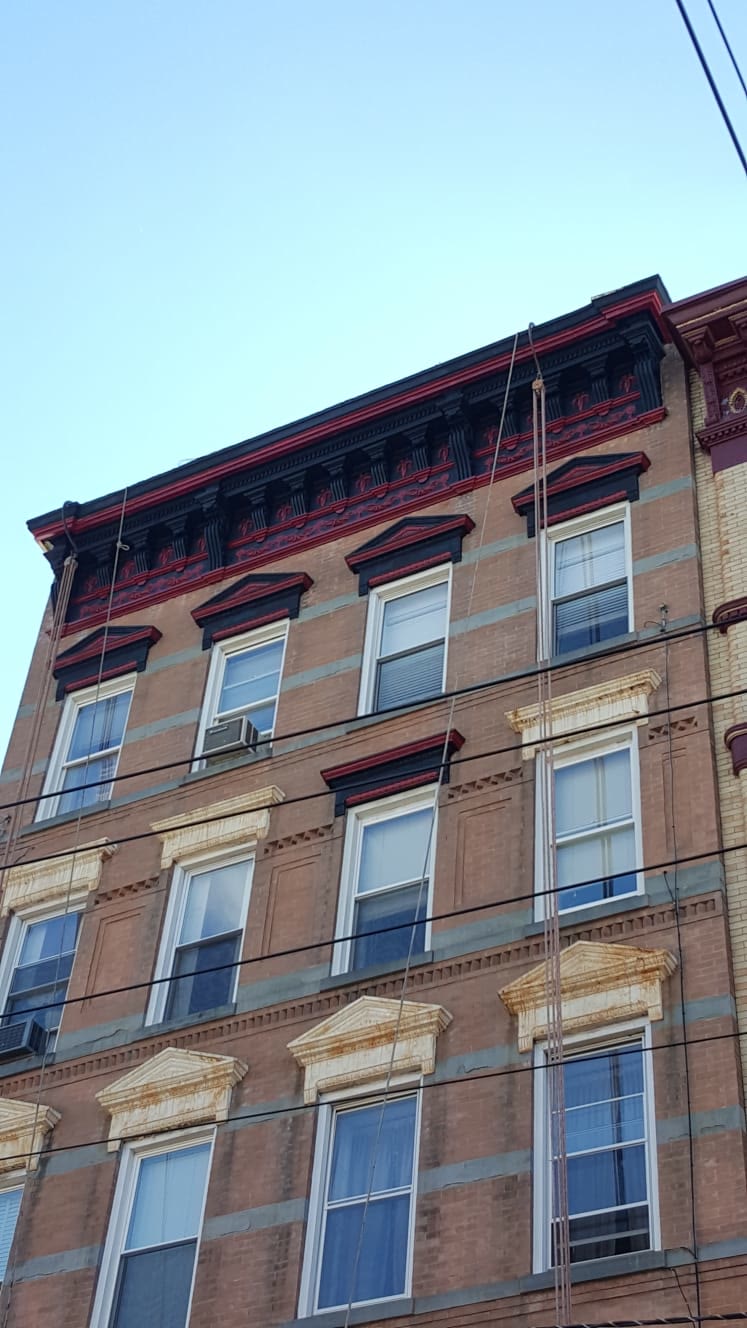
The most reliable sign is erosion. Once the mortar has worn back roughly a quarter inch or more from the face of the brick, water sits in the recess and works its way in. Mortar that turns to sand when you scratch it with a key has lost its binder. Hairline gaps between the mortar and the edge of the brick let water straight into the wall even when the joint looks full. Loose brick, cracks running through the joints, plants growing out of the wall, and water stains inside are all later signs of the same problem. Our posts on brick wall leaks and cracks in brick go into those in more detail.
Check the parapet and the top few floors first. They take the most weather and usually need repointing years before the rest of the building.
How it should be done
Repointing looks simple, and a lot of it gets done badly. Here's what good work involves, which is also what to ask any contractor about before you sign.
Rake to the right depth. Old mortar should come out to a depth of about two to two and a half times the width of the joint, which on standard brick with 3/8-inch joints means around 3/4 inch. Anything shallower leaves a thin skin of new mortar sitting on weak old mortar, and it falls out within a few years.
Don't damage the brick getting there. Hand tools are the gentlest method. Grinders are faster and often acceptable on newer, harder brick, but in unskilled hands they nick the brick edges and widen the joints, which permanently changes how the wall looks. On older and landmarked buildings, expect at least the vertical joints to be done by hand.
Use a mortar that's softer than the brick. Getting this wrong is the most common mistake we see, and the one that does the most damage. Modern high-cement mortar is harder and less porous than the soft brick in most prewar buildings. When the wall moves or gets wet and freezes, the stress goes into the brick instead of the joint, and the brick faces break off. Prewar walls usually need a lime-rich mortar. A mortar analysis or a look at the existing sound mortar will tell your mason what to match.
Fill in layers. Deep joints should be filled in lifts of about a quarter inch, each one allowed to firm up before the next goes in, so the mortar doesn't slump or shrink away from the brick.
Match the joint profile and color. Concave, flush, struck and weathered joints all look different from the street, and new joints should match the original in shape and width. Test panels are worth the day they take, especially on a building that will be repointed in sections.
Work in the right weather. Mortar needs temperatures above about 40°F to cure properly, and it shouldn't dry out too fast in hot sun or wind. In New York, that means exterior repointing runs from spring into late fall, with the hottest weeks of summer calling for shading or misting.
Spot repointing or the whole wall?
Spot repointing makes sense when the damage is limited to a few areas, such as around a leaking downspout or along a parapet, and the rest of the wall is sound.
Once more than about a quarter of the joints on an elevation need work, we'd usually recommend repointing the whole elevation. By then, the rest of the mortar is the same age and close behind. On a tall building, you're paying for scaffolding or a swing stage either way, and access is often the largest single cost. And patchwork repointing rarely matches, so the wall ends up as a patchwork of mortar colors. If you'll need to come back in five years, it's usually cheaper to do it once.
What it costs
Typical NYC repointing runs about $18 to $35 per square foot of wall, depending on how hard the old mortar is to remove, whether the joints are raked by hand, the mortar and color matching required, and how much the crew has to move around between scattered areas. That doesn't include scaffolding, swing stages or a sidewalk shed, which on a building over a few stories can equal or exceed the cost of the repointing itself. True tuckpointing costs more than repointing because of the second step and the skill involved. Our repair cost guide walks through how these pieces add up on a facade job.
Done right, repointing should last 25 years or more on most walls. Parapets, chimneys and elevations that take heavy wind-driven rain wear out sooner.
Mistakes to watch for
A few shortcuts show up again and again. Smearing a thin coat of mortar over the old joints without raking them out (sometimes called slurrying or skim pointing) looks tidy for a season and then flakes off. Hard, gray portland cement mortar on soft old brick causes the spalling described above. Caulk in place of mortar traps water and looks wrong. Joints ground wider than the originals can't be made narrower again. And pressure washing new work before it has cured can blow fresh mortar right out of the joints.
If you're getting bids, ask each contractor how deep they'll rake, whether any of the work will be done by hand, what mortar they plan to use, and whether they'll do a test panel. A contractor who does this work well will answer all four without hesitating.
Repointing and your facade inspection
On buildings taller than six stories, eroded and open joints are among the most common items in a SWARMP facade report, and loose brick from long-neglected joints can push a building to Unsafe. If your building is in FISP sub-cycle 10A, the report is due February 21, 2027, and repointing done before your inspector's close-up shows up in the report as corrected rather than as a condition. Our Cycle 10 guide has the deadlines for every sub-cycle.
Get a repointing price you can compare
NYC Superior Construction repoints and restores brick facades across New York City, Nassau, Westchester and Rockland counties, and Central and North New Jersey. We'll tell you how deep we rake, what mortar we'll use and why, and whether you need spot repointing or the whole elevation. Send us photos or your facade report and we'll give you a realistic scope and price. See our masonry restoration work for more.
Frequently asked questions
What's the difference between repointing and tuckpointing?
Repointing replaces deteriorated mortar. Tuckpointing, strictly, is a decorative two-color finish with a thin contrasting line of mortar that makes joints look fine and uniform. In everyday American usage, many people say tuckpointing when they mean repointing.
How do I know if my brick needs repointing?
Mortar eroded back about a quarter inch or more, mortar that crumbles when scratched, gaps between mortar and brick, loose brick, and leaks are the common signs.
How much does repointing cost in NYC?
About $18 to $35 per square foot of wall, plus access. On taller buildings, scaffolding and sheds can cost as much as the repointing.
How long does repointing last?
25 years or more when done with compatible mortar at the right depth. Parapets and chimneys wear faster.
This article is general information about masonry repair, not engineering advice. Cost ranges are typical figures for planning, not a quote. Last reviewed: September 22, 2026.